Feb 26, 2026 | AI Search, Dental Marketing, Search Engine Optimization
Multi-Location Dental SEO: The 2026 Local Ranking Playbook
Multi-location dental practices and regional groups face a unique challenge in 2026. Growth is no longer just about adding locations. It is about making sure each location competes effectively in its own market while strengthening the overall brand.
Many dental groups expand through acquisition. They inherit websites, Google Business Profiles, inconsistent branding, and fragmented review systems. The result is predictable: diluted visibility, keyword cannibalization, and underperforming local rankings.
Local SEO for multi-location dental practices requires structure, governance, and operational discipline. It is not simply a scaled-up version of single-practice SEO.
This playbook breaks down how growth-stage regional groups and DSOs should approach local SEO in 2026.
The Core Challenge of Multi-Location SEO
When you operate multiple offices, you are solving three simultaneous problems:
- Each location must rank locally.
- The brand must build domain-level authority.
- Locations must not compete against each other.
If even one of those fails, performance suffers.
For example, when two offices in nearby suburbs both try to rank for “dental implants Nashville,” search engines may rotate visibility between them. Neither performs as strongly as a single, clearly differentiated location would.
The solution is architectural clarity.
Step 1: Build Clean Location Architecture
Multi-location dental sites should follow a structured hierarchy.
Example structure:
- /locations/nashville/
- /locations/franklin/
- /locations/murfreesboro/
Each location page must function as its own locally optimized asset.
A strong location page includes:
- Unique introductory copy specific to the community.
- Provider bios for that office.
- Location-specific testimonials.
- Embedded Google Map for that address.
- Structured NAP (Name, Address, Phone) consistency.
- Clear services offered at that location.
- Unique FAQ section reflecting real patient questions.
The biggest mistake multi-location groups make is cloning content and swapping city names. Search engines detect duplication easily. This weakens ranking potential and reduces trust signals.
Every location must feel real, distinct, and grounded in its community.
Step 2: Avoid Keyword Cannibalization
Keyword cannibalization occurs when multiple pages on the same domain compete for the same search term.
For multi-location practices, this commonly happens when:
- Corporate-level service pages target broad city keywords.
- Location pages also target those same keywords.
- Blog posts accidentally compete for high-value service terms.
For example, if you have:
- /dental-implants/
- /locations/nashville/dental-implants/
- /locations/franklin/dental-implants/
You must define intent carefully.
A recommended approach:
- Corporate service page: general authority and education.
- Location service pages: geographically specific targeting.
- Internal linking reinforces hierarchy.
Without clear intent separation, rankings become unstable.
Step 3: Balance Corporate Authority and Local Authority
Regional groups need both brand strength and geographic specificity.
Corporate pages build:
- Backlinks
- Brand mentions
- Media exposure
- Overall domain authority
Location pages build:
- Local pack visibility
- “Service + city” rankings
- Community relevance
The mistake is over-centralizing or over-fragmenting.
If everything lives at the corporate level, local rankings weaken.
If every location tries to operate like its own domain without internal linking support, authority fragments.
The correct model links:
Corporate service hubs → Location pages → Supporting blog content
This reinforces expertise while allowing each location to rank independently.
Step 4: Optimize Google Business Profiles at Scale
Every location should have:
- Its own verified Google Business Profile.
- Correct primary and secondary categories.
- Consistent NAP across citations.
- Updated photos quarterly.
- Ongoing review acquisition.
Review velocity is especially important in competitive Southeast markets.
Top-performing multi-location dental groups often add 15–30 new reviews per location per month.
Without consistent review growth, even strong websites struggle in map pack visibility.
Create a standardized review acquisition workflow:
- Post-appointment text/email automation.
- Front desk scripting.
- Monthly performance tracking by location.
- Manager accountability.
Local SEO for multi-location groups is operational, not just technical.
Step 5: Implement Structured Data at Location Level
Structured data helps search engines interpret your business clearly.
For multi-location groups, this means:
- Organization schema at the corporate level.
- LocalBusiness schema for each location.
- Dentist schema for providers.
- FAQ schema for service pages.
This improves eligibility for rich results and enhances clarity in AI-generated summaries.
Structured entity consistency also improves GEO performance because AI systems rely on accurate entity understanding.
Enterprise-level reporting should include:
- Organic traffic per location.
- Map pack ranking trends.
- Call volume per location.
- Leads by service category.
- Conversion rate per landing page.
- Cost per acquired patient by region.
Without location-level dashboards, marketing decisions become reactive and anecdotal.
Growth-stage regional groups must operate with centralized visibility.
Step 7: Local Content That Supports Real Demand
Beyond service pages, each location should develop:
- Community-focused content.
- Locally relevant blog posts.
- Event sponsorship mentions.
- Area-specific FAQs.
This builds geographic depth and increases long-tail visibility.
AI-driven search also benefits from this because conversational queries often include localized phrasing.
GEO Considerations for Multi-Location Groups
Generative Engine Optimization (GEO) matters even more for multi-location brands.
AI systems need to clearly understand:
- Which location serves which geography.
- Which providers operate at which address.
- Which services are available at each office.
- How the brand presents expertise consistently.
Inconsistent location data can result in incorrect AI summaries or mismatched addresses.
GEO best practices for multi-location dental practices include:
- Clear internal linking between corporate and location pages.
- Distinct location FAQs.
- Consistent service descriptions with geographic qualifiers.
- Entity clarity across all citations.
Common Mistakes Multi-Location Practices Make
- Duplicating content across locations.
- Ignoring review velocity differences.
- Competing internally for the same keywords.
- Not tracking leads per location.
- Treating SEO as a centralized marketing task without operational accountability.
Multi-location SEO requires coordination between marketing leadership and local office managers.
Final Thoughts
Local SEO for multi-location dental practices in 2026 is about clarity, structure, and discipline.
Each location must be strong enough to rank independently.
The brand must be cohesive enough to build authority collectively.
When SEO and GEO are integrated correctly, regional groups gain a significant competitive advantage in both map visibility and AI-enhanced search surfaces.
Related reading: The Definitive 2026 Dental SEO & AI Search Blueprint and How AI Search Is Changing Patient Acquisition for Dentists.

Jun 11, 2025 | AI Search, Search Engine Optimization
Why 2026 Is the Year Your Practice Can’t Afford to Ignore Local SEO
The way patients find healthcare providers is evolving rapidly—and 2025 is shaping up to be a watershed year for dental and healthcare practices that want to grow. With more patients searching online for care, local SEO is no longer just a marketing buzzword; it’s a critical strategy for attracting new patients and staying competitive.
The Digital Shift in Patient Behavior
Over the past decade, the healthcare industry has seen a massive shift toward digital. Patients are now empowered with smartphones, voice assistants, and instant access to information. According to a recent [BrightLocal survey], 98% of consumers used the internet to find information about a local business in 2024, and healthcare is no exception. When someone needs a new dentist, pediatrician, or specialist, their first step is usually a Google search—often for terms like “dentist near me” or “best family doctor in [city].”
If your practice isn’t showing up in these local searches, you’re missing out on a steady stream of new patients.
What Is Local SEO for Healthcare Practices?
Local SEO (Search Engine Optimization) is the process of optimizing your practice’s online presence so you appear prominently in location-based search results. This includes Google Maps, local business directories, and the highly visible Google local 3-pack that appears at the top of search results for local queries.
For healthcare practices, local SEO means making sure that when someone searches for services you offer in your area, your practice stands out—complete with accurate information, positive reviews, and easy ways to contact you.
Why Local SEO Is More Important Than Ever in 2025
1. Patients Expect Convenience and Trust Online Results
Today’s patients expect to find healthcare providers quickly and conveniently online. They rely on Google not just for information, but for recommendations they can trust. According to [PatientPop], 75% of people have looked online to find out about a doctor, dentist, or medical care, and 60% have chosen one provider over another based on a strong online presence.
2. Competition Is Increasing
More practices are investing in digital marketing, making local search results more competitive. If your competitors are showing up in the local 3-pack and you’re not, you’re likely losing patients to them—even if you offer superior care.
3. Local SEO Drives Real Results
Local SEO isn’t just about visibility; it’s about conversions. Google reports that 76% of people who search for something nearby visit a business within a day, and 28% of those searches result in a purchase or appointment. For healthcare, that means more new patient calls, appointment bookings, and long-term relationships.
Key Local SEO Strategies for Healthcare Practices

1. Claim and Optimize Your Google Business Profile
Your Google Business Profile (formerly Google My Business) is the cornerstone of local SEO. Make sure your profile is fully completed with your practice’s name, address, phone number, website, business hours, and a detailed description of your services. Upload high-quality photos of your office and staff, and keep information up-to-date.
2. Encourage and Respond to Patient Reviews
Online reviews are a major ranking factor for local search and a key trust signal for patients. Ask satisfied patients to leave positive reviews, and always respond—thanking patients for their feedback or addressing any concerns. According to [Podium], 93% of consumers say online reviews impact their decisions.
3. Use Localized Keywords on Your Website
Incorporate location-specific keywords naturally throughout your website. Instead of just “teeth whitening,” use “teeth whitening in [City, State].” Create service pages and blog posts that address local health concerns or events, and include your city, neighborhood, and nearby landmarks.
4. Build Location-Specific Landing Pages
If your practice has multiple locations, create dedicated landing pages for each one. Include the address, phone number, unique services, and testimonials for each location. This helps Google match your practice with hyper-local searches.
5. Ensure Consistency Across All Listings
Your practice’s name, address, and phone number (NAP) must be consistent everywhere—your website, Google Business Profile, directories, and social media. Inconsistencies can confuse both Google and potential patients, hurting your rankings and credibility.
6. Optimize for Mobile and Voice Search
With most local searches happening on mobile devices, your website needs to be fast, mobile-friendly, and easy to navigate. Increasingly, patients are using voice assistants to search for providers (“Hey Siri, find a dentist near me”), so optimize your content for conversational queries and FAQs.
The Risks of Ignoring Local SEO
Practices that neglect local SEO risk being invisible to patients searching for care in their area. As more competitors invest in digital marketing, falling behind in local search means missing out on new patient appointments and growth opportunities. In a world where convenience and trust are paramount, being hard to find online can be a dealbreaker for prospective patients.
Taking Action: How to Get Started
If you haven’t yet invested in local SEO, 2025 is the year to start. Begin by claiming your Google Business Profile, updating your website with local keywords, and asking your happiest patients for reviews. Monitor your local search rankings and adjust your strategy as needed.
For practices ready to take their digital presence to the next level, working with a healthcare marketing agency can provide a customized local SEO strategy, ongoing optimization, and measurable results.
Ready to grow your practice?
Explore Harris & Ward’s SEO for Healthcare Practices and Dental Website Design services to get expert help tailored to your needs.
Jan 7, 2025 | Google, Search Engine Optimization
Understanding Google Search Volatility: What It Means for Your Business
In the dynamic world of digital marketing, change is the only constant—especially when it comes to Google’s search algorithm. Businesses relying on organic search traffic know how crucial it is to stay ahead of updates, fluctuations, and trends in Google’s search behavior. At Harris & Ward, we’re committed to helping our clients navigate these changes effectively.
If you’ve been noticing recent fluctuations in your website’s rankings, you’re not alone. Google search volatility has been a hot topic in the SEO community, with many marketers turning to tools like SEMrush to track and analyze these shifts.
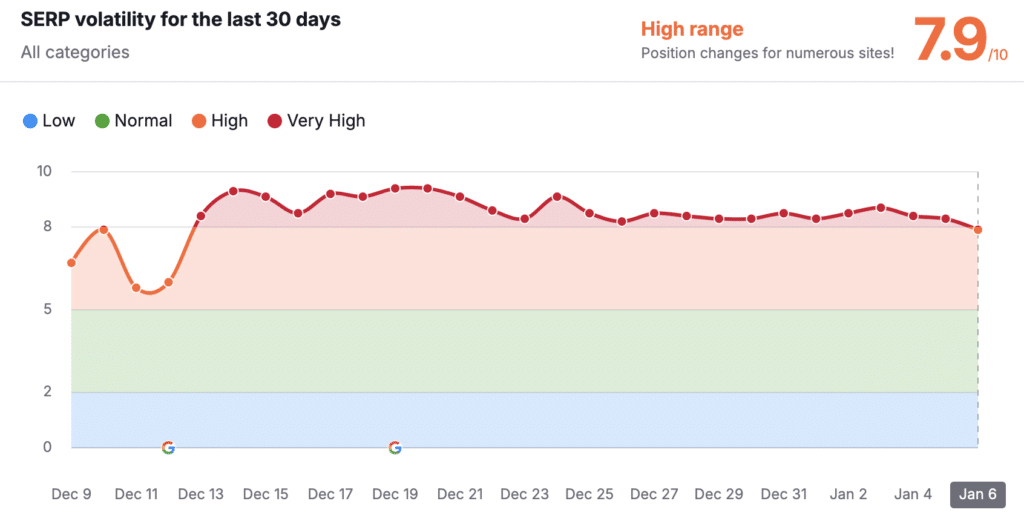
What is Google Search Volatility?
Google search volatility refers to the measurable fluctuations in search rankings across various industries and keywords. This volatility often signals an algorithm update, either planned or unannounced. These updates can reshape search engine results pages (SERPs), leading to significant gains or losses in visibility for businesses.
The Current State of Search Volatility
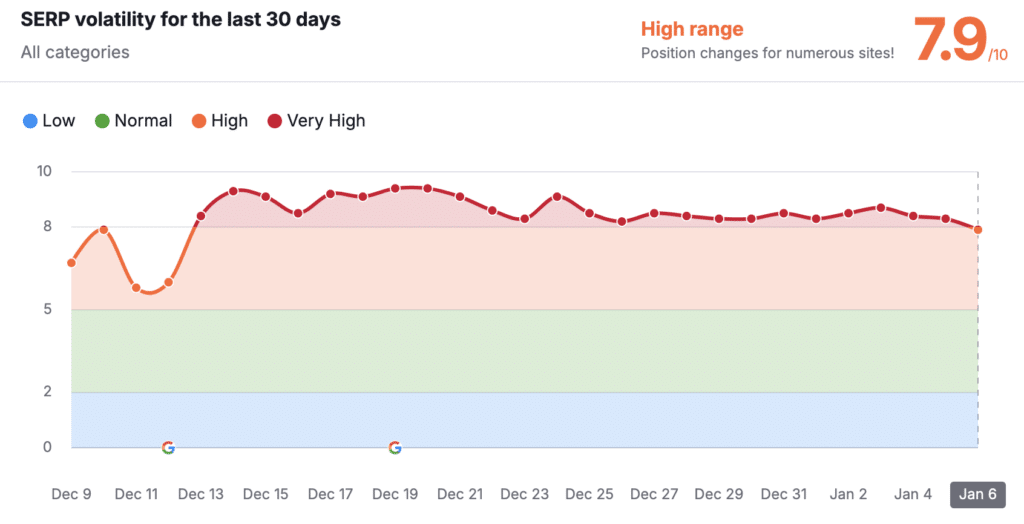
According to recent data from SEMrush’s Sensor tool, the level of volatility in Google’s search results is unusually high. Below is a screenshot showcasing the latest trends:
[Insert Screenshot Here: SEMrush Screenshot Highlighting Volatility]
This spike in activity could indicate algorithm updates, seasonal trends, or even a shift in user search behavior. Regardless of the cause, businesses must adapt their strategies to maintain or improve their online visibility.
Key Causes of Google Search Volatility
- Algorithm Updates: Google’s regular algorithm updates—from broad core updates to niche adjustments—often result in volatility. Recent updates have focused on content quality, site performance, and user experience.
- Seasonality: Search trends can fluctuate based on the time of year. For example, the holiday shopping season typically sees increased competition for retail-related keywords.
- Competitor Activity: Changes in a competitor’s SEO strategy—such as launching new content or earning high-quality backlinks—can also contribute to shifts in rankings.
- Google’s Testing: Google frequently experiments with new features, layouts, and ranking signals, which can temporarily impact search results.
Why Search Volatility Matters for Your Business
Search volatility isn’t just a number on a graph; it has real-world implications for businesses:
- Traffic Fluctuations: Rankings changes can lead to sudden drops or surges in website traffic.
- Revenue Impact: For e-commerce businesses, even slight ranking drops can translate to significant revenue losses.
- Content Strategy Adjustments: Volatility may signal the need to revisit and optimize your content.
How to Respond to Search Volatility
- Monitor Your Rankings: Use tools like SEMrush, Ahrefs, or Google Search Console to track changes in your rankings. Understanding what’s happening is the first step toward addressing it.
- Focus on High-Quality Content: Google’s updates consistently prioritize content that is relevant, authoritative, and user-focused. Regularly update your website with fresh, valuable content.
- Improve Site Performance: Page speed, mobile-friendliness, and overall usability are critical ranking factors. Ensure your website meets Google’s performance standards.
- Diversify Your Traffic Sources: Relying solely on organic traffic is risky during periods of high volatility. Invest in paid ads, email marketing, and social media to balance your traffic.
- Leverage Local SEO: If your business serves a local audience, prioritize local SEO strategies. Optimize your Google Business Profile, build local citations, and encourage customer reviews.
Insights from Industry Experts
To provide further context, we’ve gathered insights from SEO industry leaders:
- Marie Haynes notes that content quality and expertise are becoming increasingly critical ranking factors.
- Barry Schwartz emphasizes the importance of staying agile during algorithm updates and using historical data to identify patterns.
- John Mueller (Google): Recommends focusing on long-term SEO strategies rather than reacting impulsively to short-term ranking changes.
- SEMrush Sensor: Tracks daily SERP fluctuations across industries and provides a volatility score.
- MozCast: Visualizes Google algorithm activity and highlights potential updates.
- Rank Ranger: Offers in-depth insights into ranking shifts and helps identify trends.
- Google Search Console: Provides direct data from Google about your website’s performance in search results.
Proactive Strategies for 2025
As we look ahead, staying proactive is essential. Here are some strategies to future-proof your SEO:
- E-A-T (Expertise, Authority, Trust): Build your website’s credibility by showcasing expert content and earning high-quality backlinks.
- Core Web Vitals: Ensure your website passes Google’s metrics for loading, interactivity, and visual stability.
- AI-Driven Optimization: Use AI tools like ChatGPT to enhance content creation and keyword targeting.
- Voice Search Optimization: Adapt your content for conversational queries to capture voice search traffic.
Harris & Ward’s Approach to Navigating Volatility
At Harris & Ward, we’re no strangers to the challenges of search volatility. Here’s how we help our clients thrive:
- Data-Driven Analysis: We use tools like SEMrush to identify patterns and opportunities.
- Custom SEO Strategies: Our tailored plans ensure that your website remains competitive.
- Content Excellence: We prioritize creating high-quality, optimized content.
- Transparent Communication: We keep our clients informed about changes and recommended actions.
Conclusion
Google search volatility is an inevitable part of digital marketing, but it doesn’t have to derail your business. By staying informed, investing in quality strategies, and partnering with experts like Harris & Ward, you can turn volatility into opportunity. If you’re ready to secure your online presence and drive results, schedule a complimentary strategy call with us today.

Jun 22, 2023 | Chiropractor Marketing, Google, Search Engine Optimization
In the realm of Search Engine Optimization (SEO), link building stands tall as a fundamental strategy for boosting website visibility and driving organic traffic. By strategically acquiring high-quality backlinks, websites can improve their search engine rankings, establish credibility, and attract relevant audiences. This article delves into the significance of link building efforts in SEO, while shedding light on the differences between blog posts, guest posts, and link outreach initiatives.

The Essence of Link Building
Link building serves as the process of acquiring hyperlinks from other websites to your own. Search engines interpret these links as a vote of confidence, signaling that your website offers valuable and authoritative content. In essence, link building is the digital equivalent of word-of-mouth marketing. It helps search engines recognize your website’s relevance and establishes connections that lead to higher rankings.
- Enhancing On-site Link Building: Publishing blog posts on your own website is an excellent way to build a strong foundation for link building efforts. By creating high-quality, informative, and engaging content, you attract readers and increase the chances of obtaining organic backlinks. Each blog post should include internal links, which connect different pages of your website, promoting smooth navigation for users and improving search engine visibility.
Internal links play a crucial role in enhancing the user experience by guiding visitors to relevant pages within your website. From an SEO perspective, internal links distribute the ranking authority across your site, ensuring that all pages have a fair chance of appearing in search results. Additionally, internal links help search engine crawlers discover and index your content more efficiently, improving overall visibility.
Furthermore, blog posts can act as a source of external link building when other websites find your content valuable and link back to it. By consistently producing high-quality blog posts, you establish your website as an authority in your niche, making it more likely for others to reference and link to your content. This, in turn, boosts your website’s credibility and visibility in search engine rankings.
- Expanding Outreach Horizons: Guest posting involves writing articles for external websites within your industry or niche. It allows you to tap into a new audience while gaining valuable backlinks. When contributing a guest post, you can strategically insert relevant links back to your own website. These links serve as a gateway for new users to discover your content and explore your website. Guest posts not only enhance your website’s visibility but also establish your authority within your industry.
Guest posting provides an opportunity to showcase your expertise and reach a broader audience beyond your existing user base. By crafting well-researched and insightful articles, you can capture the attention of readers on authoritative websites. The links you include within the guest posts direct interested readers to your website, increasing traffic and potentially converting them into loyal followers or customers.
When pursuing guest posting opportunities, it is crucial to target reputable and relevant websites. A thorough analysis of their domain authority, readership, and engagement will help you identify suitable platforms for collaboration. By contributing valuable content and adhering to the guidelines of each website, you build a positive relationship with the host website, potentially opening doors for future collaborations and gaining even more visibility and backlinks.
- Forging Connections: Link outreach, also known as link building outreach, is a proactive approach to acquire backlinks. It involves reaching out to website owners, bloggers, and influencers, requesting them to link to your content. Link outreach requires personalized and compelling pitches, highlighting the value and relevance of your website. It is essential to target authoritative websites and build genuine relationships based on mutual interests. Through link outreach, you can expand your network, gain exposure to a wider audience, and strengthen your website’s credibility.
Successful link outreach campaigns begin with identifying target websites that align with your industry or niche. Look for websites that are likely to benefit from linking to your content, such as resource pages, round-up posts, or articles related to your expertise. Craft personalized and concise outreach emails that clearly articulate the value your content provides to their audience and explain why linking to your website would be beneficial.
When conducting link outreach, it is crucial to focus on building genuine relationships rather than simply pursuing backlinks. Engage in meaningful conversations, share relevant insights, and offer support or collaboration opportunities to website owners. By demonstrating your expertise and genuine interest in their work, you increase the likelihood of securing backlinks and establishing long-term partnerships.
Additionally, link outreach can involve other strategies such as broken link building, where you identify broken links on target websites and offer your own content as a replacement. This approach helps website owners improve their user experience by replacing broken links and provides you with an opportunity to acquire high-quality backlinks.
The Role of Link Building in SEO
Link building efforts contribute significantly to SEO success. Here’s how:
- Improved Search Engine Rankings: High-quality backlinks signal search engines about your website’s relevance, boosting its rankings in search results.
- Enhanced Website Authority: Quality links from reputable sources establish your website’s authority, leading to increased trust among users and search engines.
- Increased Organic Traffic: As your website climbs the search engine rankings, it attracts more organic traffic, resulting in higher conversion rates and business growth.
- Brand Exposure and Visibility: Backlinks from authoritative websites increase your brand’s exposure, allowing you to reach a wider audience and build brand recognition.
Link building remains an integral part of any successful SEO strategy. By leveraging blog posts, guest posts, and link outreach efforts, websites can significantly enhance their online presence, climb search engine rankings, and drive organic traffic. A well-executed link building campaign fosters connections, establishes authority, and improves the overall visibility and credibility of your website. Embrace the power of link building and unlock the true potential of SEO.

Jan 11, 2023 | Chiropractor Marketing, Dental Marketing, Search Engine Optimization, Veterinarian Marketing
If you’re looking for a unique healthcare marketing agency, that has deep industry expertise that can take your practice to the next level of healthcare marketing and success, look no further than Harris & Ward. From our years of experience in the industry to our cutting-edge healthcare marketing strategies, we have what it takes to help your practice succeed. Here are five reasons why Harris & Ward is the perfect healthcare marketing agency for your needs:
We understand the needs of healthcare organizations
Harris & Ward is dedicated to providing the highest quality support to medical professionals and healthcare organizations. We understand that the healthcare industry is constantly evolving and that medical professionals need to stay ahead of the curve to remain competitive. That’s why we offer tailored solutions designed to increase efficiency and reduce the administrative burden for our clients.
Our team is committed to providing data-driven solutions to our healthcare clients. We constantly monitor industry trends, evaluate customer feedback, take innovative healthcare marketing approaches, and work in close collaboration with our clients to ensure that our services meet and exceed their expectations. By analyzing data and trends, we can help our clients make informed decisions about their healthcare marketing strategies, ensuring that they are always ahead of the competition.
At Harris & Ward, we understand that every medical professional and healthcare organization has unique needs and goals. That’s why we offer customized solutions tailored to our clients and healthcare businesses’ specific needs. Whether you are looking to increase patient volume, improve patient outcomes, or simply streamline your administrative processes, we have the expertise and resources to help you achieve your goals.
Our team of experts has years of experience in the healthcare industry, and we are dedicated to providing the highest quality service to our clients. We are passionate about what we do, and we take pride in helping our clients achieve success in medical practices. Whatever your needs may be, we are confident that Harris & Ward can help you reach whatever professional goals you have set for yourself and your practice. We make healthcare marketing easy.
We have a proven track record in delivering results
We take pride in the fact that we have a track record of delivering tangible results. Behind our success is hard work and dedication to meeting customer needs and making sure that our solutions are tailored to each individual customer journey. Our team consists of experts who have a passion for what they do and their collective experience helps us create high quality outcomes time and time again. We are dedicated to continuing this tradition of excellence so that our customers can keep seeing the safe return on their investments.
We offer a comprehensive suite of services designed for healthcare brands
Our team of healthcare marketing experts offers a suite of digital marketing services that can benefit your business in a variety of ways. We offer digital advertising solutions, search and search engine optimization, (SEO) to help increase visibility for your website, and website design and development. Our services are tailored to fit the needs of each individual customer, ensuring you get the most out of your traditional and digital advertising efforts. We guarantee satisfaction with our comprehensive suite of services that will help make your business or brand stand out from the crowd. A healthcare marketing agency located in Lexington and serving the entire country.
We are experts in healthcare marketing strategy
Our digital marketing experience spans dental and chiropractic practices. We craft effective, multi-channel campaigns that give dental and chiropractic clients a competitive advantage in the highly competitive web-based marketplace. Our team brings both an understanding of dental and chiropractic trends and brand building experience to help dental and chiropractic business grow their online presence. From keyword research to website optimization to full social media marketing and social media management, our experts provide specialized dental and chiropractic digital marketing solutions that boost new patients.
We are a full-service healthcare marketing agency
Our performance marketing agency prides itself on providing full-service solutions in every aspect of our clients’ brand strategy, performance marketing and business development, needs. We focus on the customer journey and delivering the best customer experience, with experts in a variety of disciplines taking a holistic approach to problem solving medical marketing agency that endeavors to create the most comprehensive solution for the client.
Our services range from concept to completion, enabling us to handle all aspects of a project so that our clients can rest assured it will be finished efficiently and effectively.
We understand the needs of healthcare professionals and have a proven track record in delivering results. We offer healthcare providers a comprehensive suite of services that are experts in digital marketing and medical communications. As a full-service medical marketing agency, we can provide healthcare professionals and you with everything you need to be successful online. Contact us today to learn more about our medical marketing agency and how we can help you reach your goals.
Additional Resources:
Tips for Healthcare Organizations
5 Keys Skills a Healthcare Digital Marketing Agency Provides
- Google Certified Partners
- Agency level analytics and insight
- Experts at driving new patient phone calls and visits
- Healthcare marketing benchmarks
- Knowledge of health systems and brand positioning
Google Certified Partners
Harris & Ward is a Google Certified Partner. We are experienced in using the latest tools and techniques from Google to create successful campaigns that help our clients stand out from their competition. Our certified professionals have the expertise to develop effective strategies that use the latest insights and techniques to maximize results. We are committed to staying ahead of industry trends and utilizing the most modern technologies available in order to ensure success for our clients. Our healthcare marketing agency is built to help you attract more patients through Google Ads as well as search engine optimization.
Agency level analytics and insight
At Harris & Ward, we understand that it’s not enough to just create great campaigns – it’s essential that you measure their performance. That’s why we provide comprehensive analytics insights into your campaigns so you can see exactly how they’re performing and where improvements need to be made. Our agency-level analytics give you a bird’s eye view of all your marketing efforts so you can make informed decisions about what is working best. Choosing the right healthcare marketing agency is a crucial first step in healthcare success.
Experts at driving new patient phone calls and visits
We have the expertise to build campaigns that drive measurable success in patient acquisition. Our team of experienced marketing professionals will help you create targeted campaigns that generate more qualified leads. We have a proven track record of driving phone calls and visits from targeted audiences for top healthcare companies and brands. With our full marketing expertise here, you can be confident that your campaigns are reaching the right people, with the right message, at exactly the right time.
Healthcare marketing benchmarks
We provide our clients with up-to-date market research and benchmarks for their healthcare marketing and social media campaigns so they can measure their performance against industry norms. Our experts are knowledgeable about best practices across all channels of healthcare marketing companies and will help you set realistic goals while keeping an eye on how your competition is faring. We also monitor changing trends in healthcare marketing so we can advise our clients accordingly and ensure they stay ahead of their competitors.
Knowledge of health systems and brand strategy
Our team has a deep understanding of the professional healthcare marketing agency industry and the systems that power it. Media practices rely on strong healthcare marketing agencies through paid advertising, reputation management, and seo. We use this deep industry knowledge, to help our clients strategically position their brands in the marketplace. Through careful planning, market research, and analysis, we’ll help you create a marketing plan that puts your healthcare brand in front of the right audience and drives measurable results. With our expertise, you can be sure your message will resonate with the right people and deliver meaningful ROI.
Overall, Harris & Ward is an experienced healthcare marketing agency dedicated to helping our clients reach their medical marketing goals through comprehensive services ranging from concept to completion. Our certified professionals have a thorough understanding of the latest technologies and trends in medical marketing so they can create creative campaigns tailored specifically to your needs.
Contact us today to find out more about how we can help you grow your practice through a comprehensive healthcare marketing strategy and strategic healthcare consulting plan.
Premier healthcare marketing agencies
We are here for you every step of the way
At Harris & Ward, we are committed to helping our healthcare clients succeed. Our team of digital healthcare marketing experts are dedicated to providing excellent service and delivering results for healthcare clients that exceed expectations. We understand the unique needs of healthcare professionals and strive for excellence so that our customers can keep seeing the safe return on their investments. Contact us today to see how we can help.
Our mission is simple
to help our clients grow. We understand the importance of creating strong digital foundations and executing powerful, social media marketing campaigns that produce measurable results. With Harris & Ward, you can trust that your marketing efforts and creative, social media marketing campaigns will be handled by experienced professionals dedicated to helping your business succeed in an ever-changing digital environment. Contact us today and let us show you how we can help drive success for your business.
We look forward to hearing from you!
Contact us today and let’s get started on building a successful digital marketing strategy together that will take your healthcare business to the next level. We are excited to partner with you in this journey to healthcare success, and our team is here to provide you with the best possible solutions for all of your healthcare marketing needs. Let’s work together to make sure your practice succeeds!
We invite you to explore Harris & Ward
The leading healthcare marketing agency that provides cutting-edge display advertising and search engine optimization solutions designed specifically for the healthcare industry. Our team has the experience, marketing expertise, and resources needed to help grow your online presence so that more patients find you and trust your practice. Contact us today to get started!
The team at Harris & Ward is passionate about helping our clients succeed in the digital world.
We understand a healthcare organization faces unique challenges and have specific needs when it comes to marketing their services through online and mobile marketing and social media. That’s why we tailor our services to meet those individual needs and strive for excellence in all of our endeavors. Our comprehensive suite of digital marketing and social media, services and solutions is designed to help our clients reach their goals with maximum efficiency, effectiveness, and ROI. We are committed to providing personalized service and expert guidance every step of the way so that our clients can achieve the best possible results from their video marketing and social media management campaigns.
We believe that your search engine optimization and healthcare marketing success starts with understanding each client’s individual goals and developing a strategy that meets those needs. We specialize in creating targeted search engine optimization and healthcare marketing campaigns designed to drive new patient phone calls and visits and make sure that your practice stands out from the competition. Our team leverages data-driven insights to track, measure, and optimize our clients’ campaigns for maximum impact. With Harris & Ward as your partner, you can trust that your search engine optimization and digital marketing efforts will be handled by experienced professionals dedicated to helping you succeed in an ever-changing digital environment. Contact us today and let us show you how we can help you grow your business!
We look forward to hearing from you and working together to create a comprehensive content marketing and strategy tailored specifically to your needs. Contact us today to find out more about how we can help you grow your healthcare practice. Let’s get started on building a successful digital strategy and innovative content marketing and approaches that will take your healthcare business to the next level! We are excited to partner with you in this journey and our team is here to provide you with the best possible solutions for all of your healthcare marketing, strategy and needs.
Why Harris & Ward is the Ideal Healthcare Marketing Agency
When it comes to promoting healthcare brands, a reliable healthcare marketing agency and digital marketing agency can make all the difference. Harris & Ward is the ideal healthcare marketing and advertising agency, providing comprehensive services to healthcare brands looking to make their mark in the digital world. As a healthcare digital marketing agency, we understand the unique challenges faced by healthcare brands in reaching their target audience, and we have the skills and expertise to help them achieve their goals.
Unlike many other healthcare marketing agencies, Harris & Ward is not just an average healthcare marketing agency. We are a full-service creative and healthcare marketing agency, with a deep understanding of the healthcare industry. Our team of experienced marketers, designers, and developers work together to create custom solutions that meet the unique needs of each of our clients. We specialize in all aspects of digital marketing, including SEO, PPC, and social media marketing, email marketing, and more.
At Harris & Ward, we understand that healthcare companies and brands need to be seen as trustworthy and reliable. That’s why we work hard to create campaigns that not only drive traffic and conversions but also build brand loyalty, recognition and reputation for healthcare companies and businesses. We focus our creative campaigns on creating a consistent brand message across all channels, so that our healthcare clients’ target audience sees them as the authority in their industry.
Overall, Harris & Ward is the ideal healthcare digital marketing agency and creative agency, for healthcare brands looking to take their healthcare marketing to the next level of healthcare success. With our extensive experience and expertise in healthcare digital and content marketing, we can help healthcare brands build their reputation, increase their visibility, and grow their business.
Looking to partner with leading healthcare marketing agencies? Let us show you why our creative agency is right for you! Get started today.

Sep 2, 2022 | Dental Marketing, Search Engine Optimization
Online optimization gives every business a better chance to succeed.
If you own a dental practice, you might not have considered how your online presence affects the way your business runs. After all, you offer a service that’s absolutely fundamental to living in our part of the world.
However, it’s still cutthroat out there and other practices are always competing to get patients in their doors. That’s why you need to do your best to show those potential customers that you exist and that your practice is the best choice. Local SEO services will help you do this.
Today we’re going to talk about the different ways that SEO services, typically associated with other companies, can help your dental practice bring in more patients. At the end of the day, you are operating a business and you need customers to stay alive. Let’s dig in.
The Benefits of SEO for Dental Practices
Using organic SEO will simply bring more awareness to the existence of your dental practice. Sure, you could run a perfectly successful one based on word of mouth and reputation, but you wouldn’t be giving yourself the best chance to succeed.
But how many dental practices have the time of day to focus on digital marketing? Chances are, you won’t have a marketing professional on your staff and you’d be remiss to do it yourself or have one of your office workers give it a shot.
Hiring an SEO service takes away the agonizing work of optimizing your website yourself. Here’s what you can expect from one of these valuable services.

1. Focus on Local SEO
Search engine optimization as we knew it was primarily focused on keywords and website performance to determine which sites were appropriate to display on a SERP for a given search term. Now, with local SEO, it’s taken a step or two farther.
Local SEO appeals to searches with local intent. So, if you’re someone looking for a dental practice in Fort Worth; when you type in your search terms, Google will take into account your location and display only practices near you.
As a business that operates in a static location, local SEO has to be the main focus.
2. Your Website Structure
The structure and speed of your website are some of the more important facets in appealing to Google’s algorithms. A slow and poorly laid out site is going to fall in the search rankings.
It should be easy for customers to navigate your website and find what they’re looking for within a few clicks. Categories and subcategories featuring relevant information are a must. For a dental practice, the site should be simple with only a few landing pages (about me, contact, testimonials, blog, etc.).
When you fill your landing pages with large images and unnecessary widgets, you’ll slow them down considerably. 40% of people will abandon a website if a landing page takes longer than 3 seconds to load.
3. Google My Business
Filling out your Google My Business card will improve your local search standings. If you fill out all of your pertinent information, namely the business details, your address, and contact information, then all of that will appear on Google and in maps.
More and more local searches are being conducted through map applications, so appearing on them will increase your chances of being found by your potential customers.
4. Consistent Citations
Filling out your NAP (name, address, phone number) on multiple listing sites will improve your visibility as well, but only if you fill out identical information on every platform. Inconsistent citations, which includes any online press about your practice, will lead to confusion for your customers and Google will burn you for it.
When we say consistent, we mean it. If you write “7th Street” on one listing and “Seventh St.” on another, that’s considered inconsistent. Every minute detail has to be the same.
5. Mobile Search
52% of global internet traffic is through mobile devices. If your website isn’t optimized for mobile search and mobile viewing, then you’re letting a big piece of the market pass you by. Any SEO service will be aware of this fact and advise you to build a mobile-friendly site.
6. Customer Reviews
Your dental practice should take customer reviews very seriously for obvious reasons, but also acknowledge that reviews have a big effect on your SEO. A practice that has thousands of great reviews published through various listings sites is going to rank higher than one with a few hundred good reviews.
Always encourage your customers to leave you a rating and review on the listings site of their choice. You should also promote your best ones on social media and through a testimonials page on your site.
7. Blogging
Content creation is a huge part of SEO. You can use your blog to give your audience interesting and informative articles on all things dentistry, but also to toss in relevant keywords and phrases to appeal to search.
Offering up dental guides and how-tos will establish you as an authority in your field. Don’t overstuff your posts with keywords; the information and writing should always come first. A good blog can allow your practice to transcend your local area and give you clicks from all over.
You may not like it, but people’s awareness of you is heavily predicated on your social media presence. People use Facebook, Instagram, and Twitter to find almost everything these days, including their new dentist.
Simply being on these platforms won’t do it though. Formulating a content and posting strategy with your digital marketing service will get you more followers and create more awareness around your brand. When you’ve got a great social media presence, your Google rankings will increase.
Let Us Help You with Your Business SEO Services
Great business SEO services will take all of these methods into account and help you make the most out of your online presence. Just because you’re a dentist doesn’t’ mean that you can’t bolster your business online like everyone else.
At Harris & Ward, our motto is all about helping you connect with your audience, no matter the field you’re in. Visit our page today to look at the different service that we offer and choose the one that’s right for you and the future of your dental practice.
If you found this article helpful, come back and check out our blog for more on SEO and digital marketing.