A dental practice website has one job: turn a stranger into a scheduled patient. Everything else — the design, the platform, the template vs. custom debate — is only worth discussing in that context.
We’ve built and audited enough dental websites to say this plainly: the platform decision matters far less than most agencies make it sound, and far more than most practice owners realize. The question isn’t really “custom or template?” The question is: what does your website need to do to win patients in your specific market, right now?
The answer to that question — applied honestly to your practice — is what should drive the decision. This article gives you the framework to make it.
The real question: Not “custom or template?” — but “what does my website need to do to generate patients in my market?” Everything else follows from that.
What a High-Performing Dental Website Actually Does
Before comparing platforms, it helps to define what “working” means. Based on what we see across the dental practices we work with, a website that generates patients consistently does six things well:
1
It loads fast on mobile.
More than 70% of dental searches happen on a phone. Google ranks mobile performance first. A site that takes more than three seconds to load loses a significant portion of visitors before they see a single word of your content.
2
It shows up when patients search locally.
Dedicated service pages, location-specific content, properly structured schema markup, and a maintained Google Business Profile all feed local search rankings. None of these are automatic — they have to be built intentionally.
3
It builds trust before the phone rings.
Patients evaluate a practice online before contacting it. Real team photography, authentic provider bios, embedded Google reviews, and clear treatment descriptions all do the trust-building work that converts a visitor into a call.
4
It makes booking frictionless.
Online scheduling, click-to-call buttons that work on mobile, HIPAA-compliant intake forms, and real-time availability reduce the gap between interest and appointment. Every additional step a patient has to take costs conversions.
5
It supports paid advertising without waste.
When you run Google Ads or Meta campaigns, traffic lands on your website. A site that can’t convert that traffic means you’re paying for clicks that go nowhere. Custom landing pages, fast load times, and strong calls-to-action directly affect your cost per acquired patient.
6
It gets cited by AI.
ChatGPT, Perplexity, and Google’s AI Overviews are increasingly where patients begin their search for a dentist. AI tools pull answers from sites with genuine content depth and topical authority — not boilerplate. As we covered in our piece on AEO and GEO for regional businesses, this is the new frontier of local search visibility, and your website’s content foundation determines whether you’re in that conversation at all.
Now the honest question: can a template do all six? Sometimes. Can it do all six in a competitive market, for a growing practice, over a five-year horizon? Rarely.
Templates: What They Can and Can’t Do
A template website uses a pre-built layout — often from a dental-specific platform — customized with your logo, colors, and content. They’re faster to launch and lower in upfront cost, typically under $6,000. For the right practice in the right situation, that’s a legitimate choice.
Templates work when: you’re launching a new practice or satellite location with a hard deadline, you’re in a low-competition market where local search isn’t fiercely contested, or you need a functional professional presence while you build toward something more substantial. A properly configured template — with original content, real photography, and clean technical SEO — can perform adequately in those conditions.
Templates struggle when: your market is competitive, your practice is growing, or your marketing investments need a platform that can keep pace. The structural limitations of a pre-built framework become compounding constraints: you can’t build the service page architecture local SEO demands, you can’t optimize landing pages for individual ad campaigns, and you can’t create the content depth that earns AI citations.
The duplicate content problem: When dozens of practices run on the same platform with the same underlying page structure and similar stock copy, search engines — and AI tools — struggle to differentiate them. Your practice looks like a variation on a theme, not a distinct local authority.
Custom Websites: The Case for Full Control
A custom website is built from the ground up around your practice — your services, your patient base, your market, your growth trajectory. Every architectural decision is intentional. That intentionality is what creates the compounding advantages over time.
SEO architecture built for your market
Custom sites allow you to build a complete service page structure — one dedicated, optimized page per treatment — rather than fitting your services into a template’s predetermined layout. This matters because Google’s local algorithm rewards topical depth: a practice with a well-structured page specifically about Invisalign in Lexington, KY outranks a practice whose template lumps all services onto one generic page.
Technical performance you can actually control
Google’s Core Web Vitals directly affect both rankings and whether a patient stays long enough to book. The three metrics that matter:
Metric
Target
What It Affects
LCP — Largest Contentful Paint
Under 2.5s
Rankings + first impressions
INP — Interaction to Next Paint
Under 200ms
Booking form responsiveness
CLS — Cumulative Layout Shift
Under 0.1
Visual stability, trust signals
Template platforms often load code from their underlying page builders that has nothing to do with your site’s actual content — and that bloat slows everything down. Custom builds are leaner: only the code the site needs. That performance advantage compounds across every page, every campaign, and every patient visit.
Brand differentiation that earns trust
A prospective patient visiting three dental websites in a single search session is making a trust judgment in seconds. If two of those sites look like variations of the same template — same layout, same stock photo of a smiling family, same generic headline — the practice with the distinctive, human, clearly original site wins the click.
Custom design lets you lead with what’s genuinely different about your practice: your specific team, your clinical philosophy, your patient experience. That differentiation is what converts browsers into booked appointments.
AI citation authority
When a patient asks ChatGPT “who are the best family dentists in [city],” the AI pulls its answer from sources it has determined are authoritative on the topic. That determination is based on content depth, site structure, original perspective, and topical breadth — exactly what a well-built custom site produces, and exactly what boilerplate template content cannot provide.
This is the emerging competitive edge in local dental marketing: practices whose websites are built to earn AI citations will increasingly dominate patient awareness before someone ever opens Google Maps.
The practices that win local dental search in 2027
are building that authority now — through original content, real team identity, and websites structured to be cited by AI. Templates built on shared frameworks won’t get there.
The Real Cost Comparison
Upfront cost is the most visible number. It’s rarely the most important one.
Template
Custom
Upfront cost
Under $6,000
$6,000–$15,000+
Ongoing platform fees
Often $200–$600/mo
Hosting only (~$30–$50/mo)
Content ownership
Platform-dependent
Fully yours
Scalability
Limited by framework
Built to grow with you
Campaign landing pages
Constrained or unavailable
Fully custom per campaign
5-year total cost
Often exceeds custom build
Higher upfront, lower ongoing
Proprietary dental platforms often bundle website, SEO, and advertising management — which looks convenient until you realize that leaving means losing your site, your content history, and your search equity simultaneously. Before signing anything, ask directly: “Can I export all of my content, images, and data in standard formats if I leave?” The answer tells you more than any sales deck will.
How to Make the Decision for Your Practice
This isn’t a universal answer — it’s a framework. Apply it to your specific situation.
A well-configured template is the right call if…
You need to launch in under eight weeks
You’re in a market with low local search competition
You’re validating a new location or service before committing
Budget is a genuine constraint right now, with a plan to upgrade
Custom is worth the investment if…
You’re in a competitive suburban or metro market
You’re running or planning to run paid advertising
You’re adding services, providers, or locations in the next 2–3 years
Your current site is on a platform you can’t fully control or export
Patient experience and brand perception are how you differentiate
You want to be positioned for AI search citation as that channel matures
Non-negotiable regardless of platform
Original photography — no stock images of strangers in dental chairs
Original content written for your specific practice and patient base
Mobile-first design that loads under 3 seconds
HIPAA-compliant booking and intake forms
Properly configured local SEO from launch — not retrofitted later
Schema markup so Google and AI tools understand what you offer and where
What We Look for When We Audit a Dental Website
When a dental practice comes to Harris & Ward — whether starting fresh or evaluating their current site — we look at the same things regardless of platform. These are the indicators that tell us whether a website is generating patients or just occupying a URL:
Service page depth. Does each treatment have its own dedicated page with original, specific content? Or are all services listed on one page with three sentences each?
Mobile load time. We run a PageSpeed Insights test immediately. A score below 70 on mobile is a problem. Below 50 is a conversion crisis.
Photography. Real team photos or stock? This is often the fastest signal of how seriously a practice has invested in its online identity.
Schema markup. Is the site telling Google — in structured data — who the providers are, what they treat, where they’re located, and what patients have said about them?
Content originality. Does the copy read like it was written for this specific practice, or could it describe any dental office in any city?
Conversion path. How many clicks does it take to book from the homepage? Is the phone number visible on mobile without scrolling? Is there a real call to action, or a contact form buried in the navigation?
A custom-built site gives you full control over every one of these. A template gives you partial control over some of them. The audit tells us which gaps exist — and what they’re costing the practice in missed appointments every month.
Want to know what your site is actually costing you?
We audit dental websites against the same framework above — performance, SEO structure, content depth, AI readiness, and conversion path — and tell you exactly where you’re leaving patients on the table.
A Louisville homeowner needs a kitchen remodeler. Instead of typing “kitchen remodeler Louisville” into Google, she opens ChatGPT and asks: “Who are the best kitchen remodelers in Louisville, Kentucky?” She gets a confident, conversational answer — names, brief descriptions, sometimes a direct phone number — before she ever sees a search result.
If your business isn’t in that answer, you don’t exist in that moment.
That’s the shift behind two terms you’re going to keep hearing: AEO (Answer Engine Optimization) and GEO (Generative Engine Optimization). This article explains what they actually mean, how they differ, and why they matter specifically for businesses in Kentucky and the region — in plain English, no jargon required.
The Short Version
AEO gets you into Google’s answer features. GEO gets you into AI-generated conversations. Both reward the same foundational work — and Kentucky businesses that start now have a meaningful window before local competitors catch on.
AEO vs. GEO: Search Is Changing and Why It Matters
Traditional Google search still matters. But it’s no longer where every search ends. Today’s consumers also use AI chatbots, voice assistants, and AI-generated summaries to find businesses — and in most of those formats, they get a single answer, not a list of ten links to choose from.
The chart below tells the story clearly. On traditional Google, about 60% of searches end without a click — users get their answer from a snippet or Google’s own features. Add AI Overviews and that climbs to 70%. On ChatGPT with web search enabled, it’s 78%. On Google’s full AI Mode, 93%. And in a standard ChatGPT conversation, 99% of queries never send the user to a single website.
*ChatGPT with web search enabled · **ChatGPT in standard conversation mode (no web search). Source: Peec AI / State of Search, 2025.
What the asterisks mean: ChatGPT operates in two modes. When web search is on, it performs live searches before answering — resulting in 78% zero-click. In standard conversation mode without web search, it generates answers entirely from its training data and 99% of those sessions never visit a website at all. Google’s AI Mode, at 93%, shows where Google itself is heading.
The opportunity in all of this: traffic from AI search is still happening — it’s just concentrated among fewer, higher-intent visitors. The businesses that structure their digital presence for these platforms now will capture that traffic. The ones that don’t will be invisible in an increasingly large share of the searches happening in their market.
AEO: Answer Engine Optimization
AEO focuses on getting your business into the structured answer features built directly into Google’s search results — the boxes, panels, and lists that appear before a user ever clicks a link.
What AEO targets
→
Featured snippets — the highlighted answer box at the very top of Google results, above all other listings
→
People Also Ask — the expandable question sets that appear mid-results page
→
Voice search — when someone asks Siri or Alexa a question, these devices read a single answer aloud; AEO is how you become that answer
→
Local packs and Knowledge Panels — the map results and branded info boxes that dominate local searches
How you build for AEO
AEO is built on schema markup (structured data that tells Google what your content means), FAQ sections on your website, clean and direct answers to specific questions, and consistent business information across every listing and directory.
A Lexington example
A Lexington pediatric dentist optimizes their “What age should my child first see a dentist?” page with a direct, well-structured answer. When a parent Googles that question, the practice’s answer appears as a featured snippet — above every organic result, including large hospital systems. That’s AEO in action: a small local practice winning “Position Zero” on Google.
GEO: Generative Engine Optimization
GEO is the newer discipline. While AEO is about appearing inside Google’s existing answer features, GEO is about being cited, recommended, or named by AI tools that write their own answers from scratch — ChatGPT, Perplexity, Gemini, Grok, and Claude.
Most of these tools use a process called Retrieval-Augmented Generation (RAG): when you ask a question, the AI performs live web searches behind the scenes, finds the most credible sources it can, and synthesizes an answer. Your goal in GEO is to be one of those trusted sources — and to have your brand named in the answer even when your website isn’t the one being linked.
GEO practitioners track two distinct wins:
→
Brand visibility: Your company name appears in the AI’s answer — influencing the decision even without a click
→
Website citation: Your URL is listed as a source — driving traffic and building authority
A regional example
A Louisville commercial HVAC company wants to appear when a facilities manager asks ChatGPT: “Who are the most reliable commercial HVAC contractors in Louisville?” GEO strategy here means earning mentions in trade publications, Angi, Google reviews, local business news, and LinkedIn — because those are the sources AI tools trust. The company’s own website matters, but what others say about it matters just as much.
AEO vs. GEO: Side by Side
The two disciplines are closely related but have different primary targets. Here’s how they break down:
AEO
GEO
Goal
Appear in Google’s built-in answer features
Be cited or named in AI-generated answers
Platforms
Google Search, Siri, Alexa, Google Assistant
ChatGPT, Perplexity, Gemini, Grok, Copilot
Content style
Direct answers, FAQ structure, schema markup
Same — plus external citations, brand consistency
Customer journey
User sees your answer and clicks to your site
User sees your name in AI answer and calls directly
Do you need it?
Yes — absolutely
Yes — increasingly critical
These aren’t competing strategies. The businesses that rank well on Google Maps tend to perform well in AI search too — because both systems reward the same thing: clear, specific, locally-relevant, authoritative content.
Why Kentucky Businesses Have a First-Mover Advantage Right Now
Here’s what most national agencies won’t tell you: regional markets like Lexington, Louisville, and Bowling Green are dramatically less competitive in AI search than major metros. When someone in Lexington asks ChatGPT for the best orthodontist or a commercial HVAC contractor, only a handful of businesses are competing for that mention. In Chicago or Atlanta, it’s hundreds.
The first Lexington business in any given category to build genuine AEO and GEO foundations will own that AI real estate for months — possibly years — before competitors understand what happened.
Regional EEAT signals are powerful
EEAT — Experience, Expertise, Authoritativeness, and Trustworthiness — is Google’s quality framework, and AI systems use similar logic to decide which sources to trust. For Kentucky businesses, regional signals carry real weight: a mention in the Lexington Herald-Leader, Louisville Business First, or on WDRB tells AI systems something a self-published blog post cannot. Coverage in the Lane Report, citation in a Chamber of Commerce directory, or a verified profile on a major industry platform all contribute to the external authority picture that shapes AI recommendations.
This is why local PR, earned media, and community involvement aren’t just “branding” — they’re direct inputs into how AI systems describe and recommend your business.
27%
of AI search traffic converts to leads — higher than many traditional organic traffic benchmarks. Users arriving from AI tools are already deep in their research and closer to a decision.
Source: HubSpot State of AEO Report, 2026
What Actually Moves the Needle
AEO and GEO share the same foundation. These are the five things that matter most:
01
Content that directly answers questions
Write pages that open with a clear, factual answer to the question your customer is asking — not marketing language. Use proper heading structure (H1, H2, H3), bullet lists, and FAQ sections. AI systems and Google’s SERP features reward the same format: structured, direct, and specific.
02
Schema markup
Schema is structured data that tells Google and AI tools what your content means — not just what it says. FAQ schema, LocalBusiness schema, and Review schema are the highest-impact implementations for most local businesses. Sites with multiple schema types implemented earn significantly higher AI citation rates.
03
NAP consistency and a complete Google Business Profile
Your Name, Address, and Phone number must match exactly across every directory — Yelp, Healthgrades, your local Chamber, 60+ others. AI tools cross-reference these sources before making a recommendation. A single inconsistency creates a trust gap. Your Google Business Profile should be fully complete: services listed, photos uploaded, Q&A answered.
04
Earned media and external mentions
What others say about you matters more to AI than what you say about yourself. Regional press coverage, trade publication mentions, detailed Google reviews, and profiles on authoritative directories all feed the external ecosystem that AI tools draw from when building their answers. Local PR isn’t just brand awareness — it’s a direct GEO signal.
05
Fresh content published consistently
Perplexity — one of the fastest-growing AI search tools — heavily favors content published within the past year. Recency matters. A local business blog that publishes consistently on relevant topics isn’t just feeding SEO; it’s feeding the freshness signals that AI tools actively weight in their sourcing decisions.
Test it yourself
Open ChatGPT right now and type: “Who are the best [your service] in [your city], Kentucky?” If your business doesn’t appear, you have a visibility gap. Most local competitors don’t appear either — which means the first business in your market to address this has a real first-mover advantage.
Is your business showing up when customers ask AI?
We run a free AI Visibility Audit for businesses across Kentucky and the region — testing your presence across ChatGPT, Google AI Overviews, and Perplexity, and showing you exactly what needs to change to get recommended.
No long-term contracts · Regional business specialists · Results in 30 days
Frequently Asked Questions
Do I still need SEO if I’m doing AEO and GEO?
Yes — they’re complementary, not competing. Google still handles the vast majority of search volume, and Google Maps remains the highest-converting channel for most local businesses. AEO and GEO build on top of that foundation and extend your visibility to the growing share of customers who begin their search on AI platforms. The same practices that rank well on Google Maps tend to perform well in AI search.
Are Kentucky customers actually using ChatGPT to find local businesses?
Yes, and the frequency is growing. Local businesses across Kentucky are reporting new customers who cite ChatGPT or Google AI as how they found the business. The trend is most pronounced among customers under 45. It’s not a majority of searches yet — but it’s growing fast enough that businesses who wait to act will be behind.
How quickly can I see results?
The three fastest wins: (1) fully complete your Google Business Profile — AI checks this first for every local query; (2) fix any inconsistencies in your name, address, and phone number across directories; (3) rewrite key service pages to open with direct answers rather than marketing copy, and add FAQ sections. These changes can improve AI citation rates within 4–8 weeks.
What does Harris & Ward’s AI Visibility Audit involve?
We test your business across ChatGPT, Google AI Overviews, and Perplexity using the queries your customers are actually asking. We show you where you appear, where competitors appear, and exactly what the gaps are — with a prioritized list of what to fix first. It’s free, it takes about a week to complete, and it gives you a clear picture of where you stand in AI search right now.
About Harris & Ward
Harris & Ward is a digital marketing agency founded in Lexington, KY in 2011 and headquartered at 333 E. Short Street, Suite 130, Lexington, KY 40507. We specialize in local SEO, AI search optimization, website design, Google Ads, and photo and video production for businesses across Lexington, Central Kentucky, and the United States. harrisandward.com · (859) 214-0004
Local SEO: The Importance of Responding to Google Reviews
In today’s digital landscape, online reviews have become a cornerstone of consumer decision-making. For local businesses, Google Reviews not only influence potential customers but also play a pivotal role in local search engine optimization (SEO).
Engaging with these reviews—both positive and negative—can significantly enhance a business’s online visibility and credibility.
The Role of Google Reviews in Local SEO
Google’s algorithms consider various factors when determining local search rankings, and customer reviews are among the most influential. Responding to Google reviews has a plethora of benefits. For the consumers benefit as well as Google’s algorithm. According to a study highlighted by Bird Marketing, reviews account for approximately 15.44% of the ranking factors for local SEO. This underscores that businesses with a higher volume of positive reviews are more likely to appear prominently in local search results. (bird.marketing)
Moreover, Google itself emphasizes the importance of reviews.
The Google Business Profile support page advises businesses to interact with customers by responding to reviews, stating that such engagement demonstrates value for customer feedback and can improve business visibility. (support.google.com)
Benefits of Responding to Google Reviews
Enhanced Visibility Active engagement with reviews signals to Google that your business is responsive and customer-focused, which can positively influence local search rankings.
Building Trust and Credibility Responding to reviews, especially negative ones, shows potential customers that you value feedback and are committed to addressing concerns. This transparency fosters trust and can sway undecided consumers in your favor.
Encouraging More Reviews When customers see that a business takes the time to respond to feedback, they are more inclined to share their own experiences, leading to an increased number of reviews and a more robust online presence.
Best Practices for Responding to Reviews
Timeliness Aim to respond to reviews promptly. A swift response indicates attentiveness and dedication to customer satisfaction.
Personalization Address reviewers by their names and reference specific points they made. This personal touch shows genuine engagement.
Professionalism Maintain a courteous and professional tone, even when addressing negative feedback. Avoid defensive or confrontational language.
Actionable Solutions For negative reviews, offer solutions or steps to rectify the issue. This demonstrates a commitment to continuous improvement and customer care.
The Impact of Review Engagement on Business Performance
Engaging with reviews doesn’t just enhance online visibility; it also has tangible effects on a business’s bottom line. A study cited by Chatmeter revealed that hotels responding to reviews experienced a 12% increase in review volume and a 0.12-star rating boost.
This correlation suggests that active review management can lead to improved customer perception and increased patronage. (chatmeter.com)
Furthermore, the Harvard Business Review found that a one-star increase in a Yelp rating can lead to a 5-9% increase in revenue. While this statistic pertains to Yelp, it underscores the broader principle that higher ratings and proactive engagement can directly influence consumer behavior and, consequently, business performance.
Case Study: How a Local Dental Practice Boosted Visibility & Revenue Through Review Engagement
Background: A mid-sized dental practice in Austin, Texas, was struggling to attract new patients despite having a well-optimized website. Upon conducting an audit of their online presence, it was revealed that while the practice had over 100 Google Reviews, they had never responded to any of them. Thus began their journey of responding to Google Reviews timely and often.
Action Plan: The practice implemented a structured review response strategy:
They began responding to every new review within 24 hours.
Negative reviews were handled professionally, offering patients the opportunity to resolve concerns offline.
Positive reviews were acknowledged with gratitude and personalized responses.
They encouraged satisfied patients to leave reviews via follow-up emails.
Results (Over 6 Months):
Google Business Profile rankings improved from #9 to #3 for key local search terms like “best dentist in Austin”.
Review volume increased by 35%, as more patients left reviews after seeing the practice engage with existing ones.
Click-through rate (CTR) on Google Business Profile increased by 42%, leading to more appointment bookings.
Revenue grew by 18%, attributed to a steady influx of new patients from local searches.
This case study highlights how active engagement with reviews can improve search rankings, boost customer trust, and drive measurable business growth.
Implementing an Effective Review Response Strategy
To harness the benefits of review engagement:
Monitor Reviews Regularly Utilize tools or assign team members to keep track of new reviews across platforms. Regular monitoring ensures timely responses and helps in identifying recurring feedback themes.
Develop Response Templates While personalization is key, having basic templates can ensure consistency in tone and structure, making the response process more efficient.
Empower Your Team Train staff on the importance of reviews and equip them with the skills to respond appropriately. Empowered employees can act swiftly and effectively in managing customer feedback.
Encourage Customer Feedback Proactively ask satisfied customers to leave reviews. Positive feedback not only boosts ratings but also balances out occasional negative reviews.
Key Takeaway
In the realm of local SEO, responding to Google Reviews is more than a courtesy—it’s a strategic imperative.
By actively engaging with customer feedback, businesses can enhance their online visibility, build trust, and drive growth. In an era where consumers heavily rely on online reviews, your responsiveness can set you apart from the competition and position your business for sustained success.
Dental Marketing ROI in 2026: SEO vs PPC vs Paid Social (With Realistic Benchmarks)
Dental marketing conversations often revolve around tactics.
“Should we do more Google Ads?”
“Do we need better SEO?”
“Is Facebook still worth it?”
But growth-stage practices and regional groups should be asking a different question:
Which channels produce predictable, scalable patient acquisition at sustainable cost?
In 2026, the answer is rarely one channel. It is a structured mix of SEO, GEO (AI search optimization), PPC, and paid social. Each plays a different role in the patient journey.
This article breaks down how each channel performs, what realistic benchmarks look like, and how growth-stage practices between $800,000 and $5 million should allocate budget strategically.
The Three Primary Acquisition Channels
For most dental practices, digital patient acquisition centers around:
SEO + GEO (Organic and AI-enhanced search visibility)
PPC (Google Ads and paid search)
Paid Social (Meta, Instagram, sometimes YouTube)
Each channel behaves differently in terms of speed, intent, and cost per acquisition.
Understanding those differences is critical for ROI.
SEO + GEO: Compounding Asset-Based Growth
Search Engine Optimization (SEO) improves your visibility in traditional organic search results. Generative Engine Optimization (GEO) enhances your visibility in AI-generated summaries and conversational search experiences.
Together, they create compounding acquisition.
Strengths of SEO + GEO
Long-term cost efficiency
Strong alignment with high-intent search
Increased brand credibility
Reduced reliance on paid channels over time
Improved presence in AI summaries and assistant-style results
Realistic Benchmarks
For growth-stage practices in competitive Southeast or Midwest markets:
3–6 months: ranking movement for priority service terms
6–9 months: measurable organic traffic growth
9–12 months: sustained lead flow increases
Organic traffic growth of 30–50% in year one is achievable when infrastructure and service pages are built correctly.
Long-term cost per acquired patient through SEO is often 30–60% lower than sustained paid search in high-margin service categories.
However, SEO requires patience and disciplined execution. It is not immediate.
PPC (Google Ads): Immediate Visibility with Higher Marginal Cost
Pay-per-click advertising delivers speed.
If you want to appear tomorrow for “emergency dentist near me” or “dental implants cost Nashville,” paid search can make that happen.
Strengths of PPC
Immediate traffic
Precise keyword targeting
Strong intent alignment
Clear attribution
Budget control
Challenges
Rising cost-per-click in competitive markets
Dependence on continuous spend
Conversion quality dependent on landing pages
Susceptible to bidding wars with DSOs
In many metropolitan markets:
Implant-related keywords often exceed $20–$35 per click.
Cosmetic dentistry and Invisalign keywords can also carry premium CPCs.
Emergency keywords are competitive but high-intent.
If your landing pages are not optimized, PPC becomes expensive quickly.
Cost per acquired patient through paid search varies widely, but many practices see higher short-term cost per acquisition compared to mature SEO systems.
Paid Social: Awareness and Demand Creation
Paid social is often misunderstood in dentistry.
Unlike search, social media is interruption-based. Patients are not actively searching for a dentist when scrolling Instagram or Facebook.
Multi-Location Dental SEO: The 2026 Local Ranking Playbook
Multi-location dental practices and regional groups face a unique challenge in 2026. Growth is no longer just about adding locations. It is about making sure each location competes effectively in its own market while strengthening the overall brand.
Many dental groups expand through acquisition. They inherit websites, Google Business Profiles, inconsistent branding, and fragmented review systems. The result is predictable: diluted visibility, keyword cannibalization, and underperforming local rankings.
Local SEO for multi-location dental practices requires structure, governance, and operational discipline. It is not simply a scaled-up version of single-practice SEO.
This playbook breaks down how growth-stage regional groups and DSOs should approach local SEO in 2026.
The Core Challenge of Multi-Location SEO
When you operate multiple offices, you are solving three simultaneous problems:
Each location must rank locally.
The brand must build domain-level authority.
Locations must not compete against each other.
If even one of those fails, performance suffers.
For example, when two offices in nearby suburbs both try to rank for “dental implants Nashville,” search engines may rotate visibility between them. Neither performs as strongly as a single, clearly differentiated location would.
The solution is architectural clarity.
Step 1: Build Clean Location Architecture
Multi-location dental sites should follow a structured hierarchy.
Example structure:
/locations/nashville/
/locations/franklin/
/locations/murfreesboro/
Each location page must function as its own locally optimized asset.
A strong location page includes:
Unique introductory copy specific to the community.
Provider bios for that office.
Location-specific testimonials.
Embedded Google Map for that address.
Structured NAP (Name, Address, Phone) consistency.
Clear services offered at that location.
Unique FAQ section reflecting real patient questions.
The biggest mistake multi-location groups make is cloning content and swapping city names. Search engines detect duplication easily. This weakens ranking potential and reduces trust signals.
Every location must feel real, distinct, and grounded in its community.
Step 2: Avoid Keyword Cannibalization
Keyword cannibalization occurs when multiple pages on the same domain compete for the same search term.
For multi-location practices, this commonly happens when:
Corporate-level service pages target broad city keywords.
Location pages also target those same keywords.
Blog posts accidentally compete for high-value service terms.
For example, if you have:
/dental-implants/
/locations/nashville/dental-implants/
/locations/franklin/dental-implants/
You must define intent carefully.
A recommended approach:
Corporate service page: general authority and education.
Location service pages: geographically specific targeting.
Internal linking reinforces hierarchy.
Without clear intent separation, rankings become unstable.
Step 3: Balance Corporate Authority and Local Authority
Regional groups need both brand strength and geographic specificity.
Corporate pages build:
Backlinks
Brand mentions
Media exposure
Overall domain authority
Location pages build:
Local pack visibility
“Service + city” rankings
Community relevance
The mistake is over-centralizing or over-fragmenting.
If everything lives at the corporate level, local rankings weaken.
If every location tries to operate like its own domain without internal linking support, authority fragments.
The correct model links:
Corporate service hubs → Location pages → Supporting blog content
This reinforces expertise while allowing each location to rank independently.
Step 4: Optimize Google Business Profiles at Scale
Every location should have:
Its own verified Google Business Profile.
Correct primary and secondary categories.
Consistent NAP across citations.
Updated photos quarterly.
Ongoing review acquisition.
Review velocity is especially important in competitive Southeast markets.
Top-performing multi-location dental groups often add 15–30 new reviews per location per month.
Without consistent review growth, even strong websites struggle in map pack visibility.
Create a standardized review acquisition workflow:
Post-appointment text/email automation.
Front desk scripting.
Monthly performance tracking by location.
Manager accountability.
Local SEO for multi-location groups is operational, not just technical.
Step 5: Implement Structured Data at Location Level
Structured data helps search engines interpret your business clearly.
For multi-location groups, this means:
Organization schema at the corporate level.
LocalBusiness schema for each location.
Dentist schema for providers.
FAQ schema for service pages.
This improves eligibility for rich results and enhances clarity in AI-generated summaries.
Structured entity consistency also improves GEO performance because AI systems rely on accurate entity understanding.
Step 6: Track Performance by Location
Enterprise-level reporting should include:
Organic traffic per location.
Map pack ranking trends.
Call volume per location.
Leads by service category.
Conversion rate per landing page.
Cost per acquired patient by region.
Without location-level dashboards, marketing decisions become reactive and anecdotal.
Growth-stage regional groups must operate with centralized visibility.
Step 7: Local Content That Supports Real Demand
Beyond service pages, each location should develop:
Community-focused content.
Locally relevant blog posts.
Event sponsorship mentions.
Area-specific FAQs.
This builds geographic depth and increases long-tail visibility.
AI-driven search also benefits from this because conversational queries often include localized phrasing.
GEO Considerations for Multi-Location Groups
Generative Engine Optimization (GEO) matters even more for multi-location brands.
AI systems need to clearly understand:
Which location serves which geography.
Which providers operate at which address.
Which services are available at each office.
How the brand presents expertise consistently.
Inconsistent location data can result in incorrect AI summaries or mismatched addresses.
GEO best practices for multi-location dental practices include:
Clear internal linking between corporate and location pages.
Distinct location FAQs.
Consistent service descriptions with geographic qualifiers.
Entity clarity across all citations.
Common Mistakes Multi-Location Practices Make
Duplicating content across locations.
Ignoring review velocity differences.
Competing internally for the same keywords.
Not tracking leads per location.
Treating SEO as a centralized marketing task without operational accountability.
Multi-location SEO requires coordination between marketing leadership and local office managers.
Final Thoughts
Local SEO for multi-location dental practices in 2026 is about clarity, structure, and discipline.
Each location must be strong enough to rank independently.
The brand must be cohesive enough to build authority collectively.
When SEO and GEO are integrated correctly, regional groups gain a significant competitive advantage in both map visibility and AI-enhanced search surfaces.



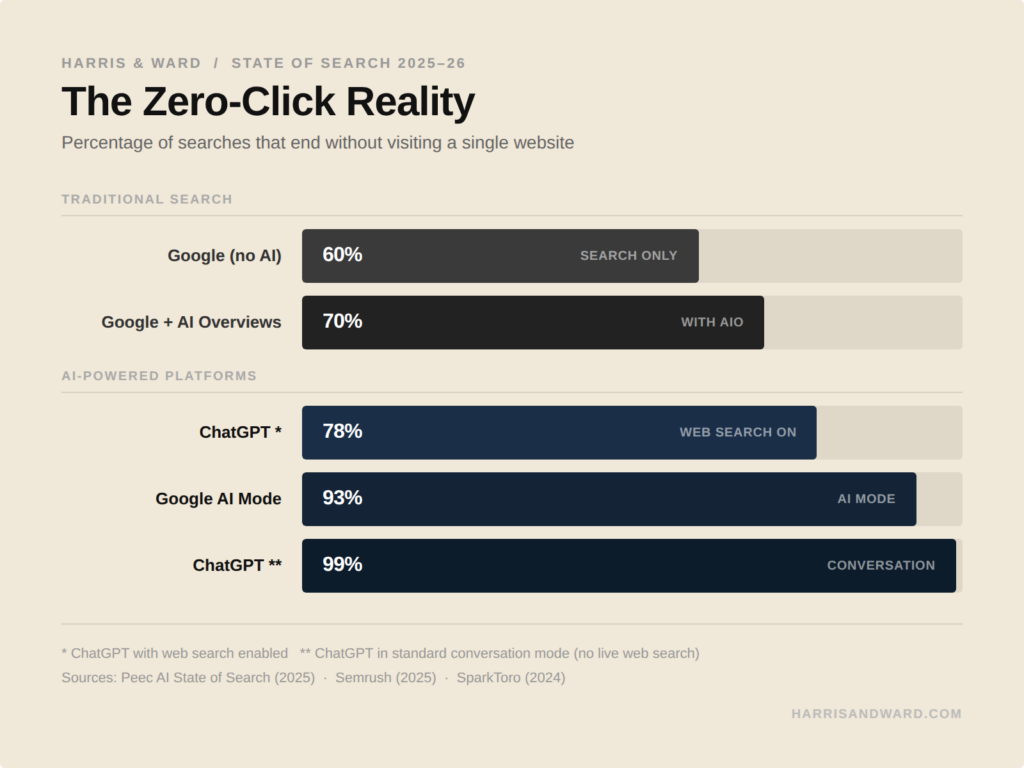 *ChatGPT with web search enabled · **ChatGPT in standard conversation mode (no web search). Source: Peec AI / State of Search, 2025.