
Mar 13, 2026 | Chiropractor Marketing, Search Engine Optimization
SEO / Healthcare Marketing / Organic Search
SEO for Chiropractors: What Matters Most and How the Right Strategy Drives Growth
If you are looking for SEO for chiropractors, the real question is not just how to rank for a few keywords. It is how to help your practice get found in Google, Google Maps, AI search results, and the moments that actually lead to calls, appointment requests, and new patients.
Search has changed. Ranking on page one still matters, but now practices also need to be understood, cited, and surfaced in AI-driven experiences. That means your SEO strategy has to go beyond keywords alone. It needs strong content, technical performance, local authority, and clear signals that help both search engines and AI platforms trust your brand.
At Harris & Ward, we help healthcare practices improve visibility where modern discovery happens: in traditional Google search, Google Maps, AI-generated search answers, and the broader content ecosystem that influences them all.
In This Guide
- What a strong chiropractic SEO strategy should actually deliver
- Why local SEO matters so much for chiropractic practices
- How AI search is changing how patients find providers
- How SEO supports visibility in Google, AI Overviews, ChatGPT, and Gemini
- What makes Harris & Ward different
- How to choose an SEO partner built for long-term growth
Table of Contents
Why SEO Matters for Chiropractors
SEO remains one of the most valuable long-term marketing investments a chiropractic practice can make. Paid ads can generate immediate traffic, but strong organic visibility compounds over time. A well-built SEO strategy helps your practice show up when people are actively searching for the exact services you offer.
SEO helps your chiropractic practice:
- Increase visibility in Google organic search
- Improve rankings in Google Maps and local search
- Generate qualified traffic from high-intent searches
- Build trust and authority in your local market
- Create sustainable lead generation without relying only on ads
- Strengthen your presence in AI-powered search experiences
For chiropractors, this matters because patients often search with immediate intent. They may be dealing with pain, looking for a provider near them, or comparing options before booking. If your practice is not visible when those searches happen, you are likely losing patients to competitors who are.

How AI Search Is Changing How Patients Find Chiropractors
Search behavior has shifted dramatically. While traditional search engines like Google still drive enormous traffic, many users are now discovering businesses through AI-powered search tools such as Google AI Overviews, ChatGPT, Gemini, and other large language model platforms.
Instead of clicking through a list of results, users increasingly ask full questions and receive summarized answers generated from multiple trusted sources across the web. These systems evaluate websites, structured content, topical authority, brand mentions, and overall trust signals to decide which businesses deserve visibility.
Key Terms You May Hear Around AI Search
- AEO (Answer Engine Optimization) – optimizing content so AI systems can easily extract and present useful answers
- GEO (Generative Engine Optimization) – improving visibility within generative search results and AI summaries
- LLMs (Large Language Models) – AI systems like ChatGPT and Gemini that interpret and generate search responses
- AI Overviews – Google’s AI-generated summaries that can appear above traditional search results
- Conversational Search – search behavior that looks more like natural language questions than short keywords
Why This Matters for Chiropractic Practices
When someone asks an AI tool for the best chiropractor marketing company, how chiropractic SEO works, or what type of marketing helps a practice grow, the system does not simply return whoever has the loudest sales copy. It tries to identify credible, relevant, and well-supported sources.
That means chiropractic practices and the agencies serving them need stronger content, clearer structure, and better authority signals than ever before.
How Modern SEO Supports AI Discovery
- Clear, structured website content
- Helpful long-form articles that answer real questions
- Strong topical authority in chiropractic and healthcare marketing
- Quality backlinks and brand mentions
- Technical website performance and accessibility
- Consistent local business signals
- Pages that are easy for both people and machines to understand
Whether the term that sticks long term is AI Search, AEO, GEO, or something else, the direction is clear: practices and agencies that publish authoritative, well-structured, genuinely helpful content are more likely to earn visibility in the next generation of search.
What a Great Chiropractic SEO Strategy Should Actually Do
Not all SEO services are built the same. Some agencies focus on vanity metrics while others focus on measurable business outcomes. The best chiropractic SEO strategy should align research, execution, and reporting around the things that actually matter: visibility, trust, calls, and patient growth.
1. Build a Strong Local SEO Foundation
Local SEO helps chiropractors rank in their city and surrounding markets through optimized location signals, Google Business Profile improvements, citation consistency, and stronger relevance for city-based searches.
For many chiropractic practices, local SEO is the foundation. Searches such as “chiropractor near me,” “chiropractor in Lexington,” or “back pain chiropractor near me” often drive some of the highest-intent traffic available.
2. Improve Technical SEO
Technical SEO ensures search engines can properly crawl, understand, and rank your website. This includes site speed, mobile usability, indexation, structured data, clean architecture, and overall page performance.
If your website is slow, confusing, or difficult for search engines to interpret, even strong content can struggle to perform.
3. Create Content That Matches Search Intent
Strong SEO content answers real questions. It should match what your audience is actually searching for while reinforcing your expertise through clear service pages, FAQs, blog content, and supporting resources.
For chiropractors, that may include content around conditions, treatment questions, what to expect, local service pages, and broader educational resources that help patients feel informed before they contact your office.
4. Strengthen Authority and Trust
Search engines and AI systems want evidence that your practice or brand is credible. That means quality backlinks, consistent business mentions, strong branded content, and a website that clearly communicates expertise.
This is also one reason some competitors get pulled into ChatGPT or Google AI summaries more often. They may not just have decent rankings. They may also have stronger entity signals, clearer topical structure, and more supporting mentions across the web.
5. Track the Right Metrics
Good SEO reporting should go beyond rankings. It should also track traffic, leads, calls, conversions, local visibility, and growth by service line so strategy can improve over time.
If SEO is generating impressions but not actual patient opportunities, the strategy needs refinement.
SEO Today Also Means Being Visible in AI Search
People now find answers through Google AI Overviews, ChatGPT, Gemini, and voice search experiences. Businesses that want to stay visible have to think beyond rankings alone and create content that is easy to interpret, trustworthy, and useful in multiple search environments.
Clear headings, topical depth, internal linking, structured content, and authority signals all help your business become easier to discover in both traditional search engines and AI-generated experiences.
For Harris & Ward, this is where the opportunity becomes especially important. If competitors are being cited in AI search and your brand is not showing up as often, the answer is usually not one trick. It is a combination of page structure, topical completeness, clearer entity signals, stronger supporting content, and better external reinforcement.
Why Practices Choose Harris & Ward
Harris & Ward is built for businesses that want more than generic deliverables. We focus on the work that improves visibility and supports growth over time. Our approach combines local SEO strategy, technical improvements, content development, and conversion-minded execution.
What Sets Our Approach Apart
- SEO strategies aligned with real business goals
- Strong local SEO execution for service-based healthcare companies
- Content designed for both search engines and AI discovery
- Technical and creative capabilities under one roof
- Focus on long-term authority, not short-term tricks
We understand that for many chiropractic practices, marketing success is not about vanity traffic. It is about generating the right calls, the right new patients, and long-term local visibility that continues to compound.
How to Choose the Right SEO Partner for Your Chiropractic Practice
Choosing an SEO agency is a big decision. You are not just hiring a vendor. You are choosing a strategic partner that will influence how your brand gets discovered online.
- Look for clarity: The agency should explain what they are doing and why it matters.
- Look for relevance: The strategy should fit your market, services, and goals.
- Look for substance: Great SEO includes technical work, content, local signals, and authority building.
- Look for consistency: Sustainable growth comes from ongoing execution, not one-time fixes.
- Look for business alignment: The best SEO work supports leads, calls, and revenue.
Who Is This a Good Fit For?
- Chiropractic practices that want more calls and appointment requests
- Clinics that need stronger Google Maps visibility
- Practices investing in long-term SEO strategy
- Healthcare businesses that want visibility in both Google and AI search
- Teams that want a clearer, more strategic approach to organic growth
Frequently Asked Questions About Chiropractic SEO
What is chiropractic SEO?
Chiropractic SEO refers to improving your website and online presence so it is easier for search engines and AI-powered platforms to understand, trust, and surface your practice when people search for chiropractic services.
How is chiropractic SEO different from general SEO?
The fundamentals are similar, but chiropractic SEO usually places a stronger emphasis on local visibility, Google Business Profile optimization, patient-intent content, and trust signals that matter in healthcare-related search behavior.
Can chiropractors optimize for ChatGPT or Gemini?
No one can guarantee inclusion in AI-generated answers, but practices and agencies can improve their chances by publishing strong content, building authority, maintaining technical quality, and making their website easier for machines to interpret.
Is local SEO still important in the age of AI search?
Yes. Local SEO remains critical because AI systems often rely on location signals, business profile data, local relevance, and strong regional authority when recommending service-based businesses.
How long does SEO take to work?
SEO is a long-term strategy. Some improvements can happen fairly quickly, especially with technical fixes and local optimization, but meaningful growth usually builds over several months of consistent effort.
Ready to Improve Your Search Visibility?
If you are looking for a chiropractic SEO strategy built for how search works now, Harris & Ward is ready to help. We build strategies designed to improve local visibility, strengthen organic performance, and position your brand for the future of search.
Schedule a Strategy Call

Mar 13, 2026 | AI Search, Search Engine Optimization
H&W: Rated Best SEO Company in Lexington KY
If you run a business in Lexington, Kentucky, you already know the market is more competitive than it looks from the outside. With the University of Kentucky driving a highly educated workforce, Keeneland drawing national attention twice a year, and a business community that punches well above its population weight, Lexington businesses face a unique challenge: local competition is sophisticated, and visibility on Google and AI search platforms can make or break a growth trajectory.
Harris & Ward has been headquartered at 333 E. Short Street in downtown Lexington since 2011. We’re not a national agency with a Lexington landing page — we’re a local team that goes to the same restaurants, knows the same neighborhoods, and competes for the same attention as the businesses we serve. That local context informs everything we build.
This page is for any Lexington or Central Kentucky business — from a solo healthcare practice in Hamburg to a multi-location service company in Georgetown — looking for a digital marketing partner that understands this market from the inside.
Why Local MattersA national agency can run your Google Ads. Only a Lexington agency knows that “Hamburg” and “Beaumont” are the high-growth residential corridors, that Nicholasville Road is the most competitive commercial strip in the region, and that the Keeneland fall meet brings a surge of out-of-state visitors every October that smart local businesses market into.
The Lexington Business Landscape in 2026
Lexington is a genuinely distinctive market, and the businesses that win here understand why. Greater Lexington’s economic development data shows a region growing across six major sectors — advanced manufacturing, logistics, biotech and life sciences, healthcare, food and beverage, and professional services — anchored by the University of Kentucky’s 26,000+ employees and research infrastructure, and diversified by a tech-forward workforce ranked 13th most educated in the United States.
According to the Lane Report’s 2026 Kentucky Economic Outlook, small and mid-sized businesses remain the backbone of Lexington’s growth story — but they’re navigating an increasingly complex digital environment as AI, shifting search behavior, and rising customer expectations change how buyers find and choose local providers.
What that means practically: Lexington businesses can no longer rely on word-of-mouth alone, a basic website, or even a decent Google ranking. Commerce Lexington — the region’s premier business and economic development organization — consistently identifies digital visibility as one of the top barriers to growth for local businesses, particularly in healthcare, professional services, and home services.
01
Healthcare and professional services dominate local search
Dental practices, chiropractic offices, optometrists, med spas, veterinarians, and specialty clinics represent some of the highest-intent local searches in Lexington. These are the categories where Google Maps and AI search recommendations directly translate to booked appointments — and where our team has the deepest track record.
02
The horse capital’s economy is built on reputation
From Keeneland to the bourbon trail, Lexington’s most iconic industries run on trust, heritage, and credibility. The same is true for local businesses — reviews, brand presentation, and online authority carry enormous weight with Lexington consumers. Businesses that invest in their digital reputation consistently outperform those that rely on legacy or foot traffic alone.
03
Central Kentucky’s geography creates multi-market opportunity
Lexington businesses don’t just compete for Lexington customers. Nicholasville, Georgetown, Winchester, Richmond, and Frankfort are all within 30 minutes — and patients and clients routinely travel across county lines for the right provider. A well-built local SEO strategy captures patients across Central Kentucky, not just inside Fayette County.
What Lexington Businesses Actually Need From a Digital Marketing Agency
After 14 years working with Lexington businesses — and after talking to hundreds of owners across Central Kentucky — we’ve learned that the marketing challenges facing local businesses are distinct from what national agencies typically optimize for. Here’s what actually moves the needle in this market:
Google Maps dominance — the local pack is everything
For most Lexington businesses, the Google Local Pack — the map with three listings that appears for “near me” and “[service] Lexington KY” searches — is more valuable than the entire organic results page below it. When a Lexington resident searches for a dentist, chiropractor, HVAC company, or restaurant, they almost never scroll past those three map results. Appearing in the top three is the difference between a phone ringing and silence.
Ranking in the Lexington Local Pack requires a very specific combination: a fully optimized Google Business Profile, consistent citation information across local directories, a strong and growing review base, and website content that clearly signals your location and services. This is the foundation of everything we build for local clients.
Websites that convert Lexington visitors into customers
Lexington has a sophisticated, highly educated consumer base — ranked among the top 15 most educated workforces in the United States. Lexington consumers do their research. They read reviews, compare websites, and look for authentic trust signals before they ever pick up the phone. A website that looks dated, loads slowly on mobile, or lacks real photography of your team and location will lose a significant share of that audience before you ever have the chance to earn their business.
We build websites with Lexington consumers in mind — mobile-first, fast, locally authentic, and designed to convert visits into calls, form submissions, and appointments.
AI search visibility — the new frontier in Lexington
In 2026, a growing share of Lexington consumers are finding local businesses through AI tools — asking ChatGPT, Google AI Overviews, and Siri to recommend the best dentist, the closest chiropractor, or the most-reviewed home service company in their area. The City of Lexington’s economic development initiatives specifically identify technology adoption as a key differentiator for local business competitiveness going forward.
Harris & Ward is one of the only agencies in Lexington building AI search optimization (GEO — Generative Engine Optimization) into client campaigns from day one. We structure website content, review strategies, and local data ecosystems so that when a Lexington patient or customer asks an AI tool for a recommendation, our clients are the answer.
350,000+
small businesses operate in Kentucky — and the ones growing fastest are winning on Google Maps and AI search before their competitors even know the game has changed
Source: Creekmore Marketing · Kentucky Small Business Data
The Lexington and Kentucky Businesses We Help Most
We work with businesses across Central Kentucky and nationally, but our deepest expertise — and our strongest results — are concentrated in these categories:
| Business type |
What we do for them |
Typical result |
| Dental practices |
Local SEO, Google Ads, website design, AI search, review strategy |
+30–50 new patients/mo within 90 days |
| Chiropractic practices |
Google Maps optimization, condition-specific SEO content, GBP management |
Top-3 Google Maps rankings for key condition searches |
| Med spas & aesthetics |
Website design, Meta ads, SEO, brand photography, reputation management |
Consistent lead flow from high-value aesthetic services |
| Home services |
Local SEO, Google Ads, website, review systems for HVAC, roofing, plumbing, moving |
Booked calendars in 30–60 days for new and established companies |
| Veterinary & equine |
Website design, local SEO, equine brand photography, content strategy |
Dominant local visibility in a niche where Lexington is the national capital |
| Professional services |
Website redesign, SEO, branding, Google Ads for law firms, financial advisors, consultants |
Credibility-building that converts high-value clients |
“Harris & Ward really helped to turn around our orthodontic practice marketing. They rebuilt our website, came to our offices to shoot the videos and stills, and successfully grew our organic search and Google Business Profile. Todd and his team are professional, responsive, and very easy to work with.”
— Verified Google review · Orthodontic practice client · Lexington, KY
“Harris and Ward turned our company around in 3 months. Great attention to detail, great value for the money. Corey, Todd, Seth and Sierra moved heaven and earth for us.”
— Verified Google review · Business services client · Lexington, KY
Our Digital Marketing Services for Lexington Businesses
We offer a full suite of digital marketing services — but unlike national agencies that spread thin across every industry and tactic, we build integrated strategies where every piece is designed to work together. Here’s how that looks in practice for a Lexington business:
01
Local SEO & Google Maps optimization
We get Lexington businesses into the Google Local Pack for the searches that drive calls and appointments. This includes Google Business Profile management, citation auditing and cleanup across 60+ directories, review strategy, and location-specific content that signals local authority to Google. The Kentucky Cabinet for Economic Development identifies digital visibility as a top priority for statewide business competitiveness — and Google Maps visibility is the first and most impactful layer.
02
Website design & development
We design and build websites for Lexington businesses that are fast, mobile-first, and built to convert — not just to look good. Every site we build includes foundational SEO architecture, clear conversion paths, and real photography from our in-house photo and video team. We come to your location.
03
Google Ads & paid search
For Lexington businesses that need results now — not in 6 months — Google Ads campaigns built specifically for the local market. We use tight geographic targeting across the greater Lexington metro (Fayette, Jessamine, Scott, Madison, Woodford, and Franklin counties) to ensure every dollar is spent reaching the customers most likely to call.
04
AI Search optimization (GEO)
Lexington consumers are increasingly using ChatGPT, Google AI Overviews, and voice assistants to find local businesses. We structure our clients’ digital presence so that when someone asks an AI tool “who’s the best [service] in Lexington KY,” our clients are the answer — not their competitors.
05
Photo & video production
Our in-house photo and video team shoots in Lexington and across Kentucky. Real photography of your team, your office, and your work is one of the most powerful trust signals for both Google search and AI recommendation — and it’s something most national agencies can’t provide with the local authenticity it requires.
Why a Local Lexington Agency Outperforms a National One for Your Business
We hear this question often: “Why does it matter if my agency is local?” Here’s the honest answer — for some businesses, it doesn’t. For most Lexington businesses, it does.
- ✓
We know the geography. Hamburg, Beaumont, Chevy Chase, downtown, Nicholasville Road, Man O’War corridor — these aren’t zip codes to us, they’re neighborhoods we live in. That geographic fluency makes our local SEO targeting, ad radius decisions, and content locality signals significantly more precise than a national agency guessing at the map.
- ✓
We know the competition. We know which businesses are dominating Google Maps in your category in Lexington, what they’re doing right, and where the gaps are. That competitive intelligence is only possible with a team that’s actively embedded in this market.
- ✓
We can show up. When you need new photography for your Google Business Profile or website, we don’t coordinate a national photography vendor — we schedule a shoot at your Lexington or Central Kentucky location. Our team has shot in Fayette, Madison, Scott, and Jessamine counties.
- ✓
We’re invested in Lexington’s success. Our business lives and dies by the reputation we build in this community. We have skin in the game that a national agency headquartered in Dallas or Seattle simply doesn’t. When you succeed, we succeed — locally and visibly.
- ✓
You work with the team. When you contact Harris & Ward, you work directly with our in-house Lexington team — not an outsourced vendor, not an offshore content farm, not an account manager in a call center. Every strategy, every piece of content, every campaign is built by people you can sit down with at 333 E. Short Street.
Our experience in this marketWe’ve helped healthcare practices in Hamburg rank above large hospital systems. We’ve helped home service businesses on Man O’War build schedules from empty to fully booked. We’ve helped professional services firms in downtown Lexington attract the caliber of client that used to go to Louisville or Cincinnati agencies. We know what works in this market because we’ve been doing it here since 2011.
What Makes SEO Different in the Lexington Market
Lexington’s competitive digital landscape has some characteristics that set it apart from other mid-size cities — and understanding them is essential for building an effective local SEO strategy.
The University of Kentucky creates a unique search ecosystem
With more than 26,000 employees and roughly 30,000 students, the University of Kentucky is Lexington’s largest employer and a significant driver of local search behavior. UK Health — the university’s healthcare system — dominates organic search for medical and dental queries across Lexington. Local independent practices and businesses competing in healthcare and professional services need a well-executed local SEO and AI search strategy to rank alongside or above that institutional authority. It’s absolutely achievable — we’ve done it repeatedly — but it requires strategy, not just basic optimization.
Central Kentucky’s interconnected geography rewards multi-area targeting
Lexington sits at the intersection of I-75 and I-64, connecting it to Nicholasville, Georgetown, Richmond, Winchester, and Frankfort within 30 minutes in every direction. Businesses that build location-specific content and SEO targeting for these surrounding communities — rather than optimizing only for Fayette County — can capture a dramatically larger patient and customer base. The Greater Lexington region’s economic development data identifies Nicholasville as one of Kentucky’s fastest-growing cities — and businesses that start showing up there digitally before competitors establish dominance have a meaningful first-mover advantage.
Keeneland and the bourbon economy create seasonal opportunity
Lexington’s identity is inseparable from Keeneland and the surrounding equine and bourbon economy. That economy brings national visitors to the market during racing meets in April and October — and those visitors are searching for restaurants, services, and experiences via Google and AI tools. Local businesses that build their digital presence to capture this seasonal search surge see measurable revenue spikes that their competitors miss entirely.
How We Work With Lexington Businesses
We don’t do discovery calls where we pitch you a package and disappear into an agency workflow. Our team works as an extension of your business — available, responsive, and invested in your results month to month.
30
Days 1–30: Audit, strategy, and foundation
We audit your current online presence — Google Business Profile, website, citation consistency, competitor positioning in the Lexington market — and build a prioritized action plan. No guesswork, no generic templates. A real plan built around your business, your market, and your 90-day goals.
60
Days 31–60: Launch and optimize
Campaigns launch. Website updates are implemented. Google Business Profile is optimized. Citation cleanup happens. If paid ads are part of the plan, they’re live within the first two weeks. You start seeing movement in calls and rankings before month two is over.
90
Day 90 and beyond: Data, scale, and growth
By day 90 you have real data — which channels are driving leads, what keywords are generating calls, where you’re ranking in the Lexington Local Pack. We report on the metrics that matter to a business owner: calls, leads, and revenue — not vanity metrics. Then we scale what’s working.
Ready to grow your Lexington business?
Let’s spend 30 minutes together. We’ll look at your current online presence, show you exactly where the opportunities are in the Lexington market, and give you a clear picture of what we’d do to help you grow — no obligation, no generic pitch deck.
Schedule a Complimentary Strategy Call
Located at 333 E. Short Street, Suite 130, Lexington, KY 40507 · (859) 214-0004 · No long-term contracts
Frequently Asked Questions From Lexington Business Owners
How long does it take to rank on Google in Lexington?
Google Ads campaigns can start driving calls within 24–48 hours of launch. Google Maps and local SEO rankings typically improve within 6–10 weeks of foundational optimization work, and compound significantly over 3–6 months. The Lexington market is competitive but not impenetrable — most of our clients see meaningful ranking movement and increased calls within the first 30–60 days.
Do you work with businesses outside of Lexington?
Yes — we work with businesses across Central Kentucky (Nicholasville, Georgetown, Richmond, Winchester, Frankfort, Versailles) and nationally, particularly in healthcare verticals. Our dental and chiropractic clients span the United States. That national experience informs what we do locally — we bring best practices from highly competitive markets in Texas, Florida, and California back to the Lexington market.
What does digital marketing cost for a Lexington small business?
Our engagements typically start at $1,200/month for local SEO and Google Business Profile management, up to full-service growth programs including paid ads, content, and AI search optimization at $3,500+/month. We don’t do one-size-fits-all pricing — we’ll tell you on our first call exactly what we’d recommend and what it costs, based on your specific market position and goals.
Are there long-term contracts?
No. We work month-to-month because we believe our results should be the reason you stay — not a contract. Most of our clients have been with us for years, but you’re never locked in. This is a meaningful commitment on our part: we have to earn your business every single month.
What industries does Harris & Ward specialize in?
Our deepest expertise is in healthcare marketing — dental practices, chiropractic offices, orthodontists, med spas, optometrists, and veterinary clinics. We also have strong track records in home services, professional services, and equine businesses. If you’re in a different industry, we’re happy to talk — we’ll tell you honestly whether we’re the right fit.
About Harris & Ward
Harris & Ward is a digital marketing agency founded in Lexington, KY in 2011 and headquartered at 333 E. Short Street, Suite 130, Lexington, KY 40507. We specialize in local SEO, AI search optimization, website design, Google Ads, and photo and video production for healthcare practices and small businesses across Lexington, Central Kentucky, and the United States. Member of the Lexington business community for 14+ years. harrisandward.com · (859) 214-0004 · Commerce Lexington member
Feb 26, 2026 | AI Search, Dental Marketing, Search Engine Optimization
Multi-Location Dental SEO: The 2026 Local Ranking Playbook
Multi-location dental practices and regional groups face a unique challenge in 2026. Growth is no longer just about adding locations. It is about making sure each location competes effectively in its own market while strengthening the overall brand.
Many dental groups expand through acquisition. They inherit websites, Google Business Profiles, inconsistent branding, and fragmented review systems. The result is predictable: diluted visibility, keyword cannibalization, and underperforming local rankings.
Local SEO for multi-location dental practices requires structure, governance, and operational discipline. It is not simply a scaled-up version of single-practice SEO.
This playbook breaks down how growth-stage regional groups and DSOs should approach local SEO in 2026.
The Core Challenge of Multi-Location SEO
When you operate multiple offices, you are solving three simultaneous problems:
- Each location must rank locally.
- The brand must build domain-level authority.
- Locations must not compete against each other.
If even one of those fails, performance suffers.
For example, when two offices in nearby suburbs both try to rank for “dental implants Nashville,” search engines may rotate visibility between them. Neither performs as strongly as a single, clearly differentiated location would.
The solution is architectural clarity.
Step 1: Build Clean Location Architecture
Multi-location dental sites should follow a structured hierarchy.
Example structure:
- /locations/nashville/
- /locations/franklin/
- /locations/murfreesboro/
Each location page must function as its own locally optimized asset.
A strong location page includes:
- Unique introductory copy specific to the community.
- Provider bios for that office.
- Location-specific testimonials.
- Embedded Google Map for that address.
- Structured NAP (Name, Address, Phone) consistency.
- Clear services offered at that location.
- Unique FAQ section reflecting real patient questions.
The biggest mistake multi-location groups make is cloning content and swapping city names. Search engines detect duplication easily. This weakens ranking potential and reduces trust signals.
Every location must feel real, distinct, and grounded in its community.
Step 2: Avoid Keyword Cannibalization
Keyword cannibalization occurs when multiple pages on the same domain compete for the same search term.
For multi-location practices, this commonly happens when:
- Corporate-level service pages target broad city keywords.
- Location pages also target those same keywords.
- Blog posts accidentally compete for high-value service terms.
For example, if you have:
- /dental-implants/
- /locations/nashville/dental-implants/
- /locations/franklin/dental-implants/
You must define intent carefully.
A recommended approach:
- Corporate service page: general authority and education.
- Location service pages: geographically specific targeting.
- Internal linking reinforces hierarchy.
Without clear intent separation, rankings become unstable.
Step 3: Balance Corporate Authority and Local Authority
Regional groups need both brand strength and geographic specificity.
Corporate pages build:
- Backlinks
- Brand mentions
- Media exposure
- Overall domain authority
Location pages build:
- Local pack visibility
- “Service + city” rankings
- Community relevance
The mistake is over-centralizing or over-fragmenting.
If everything lives at the corporate level, local rankings weaken.
If every location tries to operate like its own domain without internal linking support, authority fragments.
The correct model links:
Corporate service hubs → Location pages → Supporting blog content
This reinforces expertise while allowing each location to rank independently.
Step 4: Optimize Google Business Profiles at Scale
Every location should have:
- Its own verified Google Business Profile.
- Correct primary and secondary categories.
- Consistent NAP across citations.
- Updated photos quarterly.
- Ongoing review acquisition.
Review velocity is especially important in competitive Southeast markets.
Top-performing multi-location dental groups often add 15–30 new reviews per location per month.
Without consistent review growth, even strong websites struggle in map pack visibility.
Create a standardized review acquisition workflow:
- Post-appointment text/email automation.
- Front desk scripting.
- Monthly performance tracking by location.
- Manager accountability.
Local SEO for multi-location groups is operational, not just technical.
Step 5: Implement Structured Data at Location Level
Structured data helps search engines interpret your business clearly.
For multi-location groups, this means:
- Organization schema at the corporate level.
- LocalBusiness schema for each location.
- Dentist schema for providers.
- FAQ schema for service pages.
This improves eligibility for rich results and enhances clarity in AI-generated summaries.
Structured entity consistency also improves GEO performance because AI systems rely on accurate entity understanding.
Enterprise-level reporting should include:
- Organic traffic per location.
- Map pack ranking trends.
- Call volume per location.
- Leads by service category.
- Conversion rate per landing page.
- Cost per acquired patient by region.
Without location-level dashboards, marketing decisions become reactive and anecdotal.
Growth-stage regional groups must operate with centralized visibility.
Step 7: Local Content That Supports Real Demand
Beyond service pages, each location should develop:
- Community-focused content.
- Locally relevant blog posts.
- Event sponsorship mentions.
- Area-specific FAQs.
This builds geographic depth and increases long-tail visibility.
AI-driven search also benefits from this because conversational queries often include localized phrasing.
GEO Considerations for Multi-Location Groups
Generative Engine Optimization (GEO) matters even more for multi-location brands.
AI systems need to clearly understand:
- Which location serves which geography.
- Which providers operate at which address.
- Which services are available at each office.
- How the brand presents expertise consistently.
Inconsistent location data can result in incorrect AI summaries or mismatched addresses.
GEO best practices for multi-location dental practices include:
- Clear internal linking between corporate and location pages.
- Distinct location FAQs.
- Consistent service descriptions with geographic qualifiers.
- Entity clarity across all citations.
Common Mistakes Multi-Location Practices Make
- Duplicating content across locations.
- Ignoring review velocity differences.
- Competing internally for the same keywords.
- Not tracking leads per location.
- Treating SEO as a centralized marketing task without operational accountability.
Multi-location SEO requires coordination between marketing leadership and local office managers.
Final Thoughts
Local SEO for multi-location dental practices in 2026 is about clarity, structure, and discipline.
Each location must be strong enough to rank independently.
The brand must be cohesive enough to build authority collectively.
When SEO and GEO are integrated correctly, regional groups gain a significant competitive advantage in both map visibility and AI-enhanced search surfaces.
Related reading: The Definitive 2026 Dental SEO & AI Search Blueprint and How AI Search Is Changing Patient Acquisition for Dentists.

Jun 11, 2025 | AI Search, Search Engine Optimization
Why 2026 Is the Year Your Practice Can’t Afford to Ignore Local SEO
The way patients find healthcare providers is evolving rapidly—and 2025 is shaping up to be a watershed year for dental and healthcare practices that want to grow. With more patients searching online for care, local SEO is no longer just a marketing buzzword; it’s a critical strategy for attracting new patients and staying competitive.
The Digital Shift in Patient Behavior
Over the past decade, the healthcare industry has seen a massive shift toward digital. Patients are now empowered with smartphones, voice assistants, and instant access to information. According to a recent [BrightLocal survey], 98% of consumers used the internet to find information about a local business in 2024, and healthcare is no exception. When someone needs a new dentist, pediatrician, or specialist, their first step is usually a Google search—often for terms like “dentist near me” or “best family doctor in [city].”
If your practice isn’t showing up in these local searches, you’re missing out on a steady stream of new patients.
What Is Local SEO for Healthcare Practices?
Local SEO (Search Engine Optimization) is the process of optimizing your practice’s online presence so you appear prominently in location-based search results. This includes Google Maps, local business directories, and the highly visible Google local 3-pack that appears at the top of search results for local queries.
For healthcare practices, local SEO means making sure that when someone searches for services you offer in your area, your practice stands out—complete with accurate information, positive reviews, and easy ways to contact you.
Why Local SEO Is More Important Than Ever in 2025
1. Patients Expect Convenience and Trust Online Results
Today’s patients expect to find healthcare providers quickly and conveniently online. They rely on Google not just for information, but for recommendations they can trust. According to [PatientPop], 75% of people have looked online to find out about a doctor, dentist, or medical care, and 60% have chosen one provider over another based on a strong online presence.
2. Competition Is Increasing
More practices are investing in digital marketing, making local search results more competitive. If your competitors are showing up in the local 3-pack and you’re not, you’re likely losing patients to them—even if you offer superior care.
3. Local SEO Drives Real Results
Local SEO isn’t just about visibility; it’s about conversions. Google reports that 76% of people who search for something nearby visit a business within a day, and 28% of those searches result in a purchase or appointment. For healthcare, that means more new patient calls, appointment bookings, and long-term relationships.
Key Local SEO Strategies for Healthcare Practices

1. Claim and Optimize Your Google Business Profile
Your Google Business Profile (formerly Google My Business) is the cornerstone of local SEO. Make sure your profile is fully completed with your practice’s name, address, phone number, website, business hours, and a detailed description of your services. Upload high-quality photos of your office and staff, and keep information up-to-date.
2. Encourage and Respond to Patient Reviews
Online reviews are a major ranking factor for local search and a key trust signal for patients. Ask satisfied patients to leave positive reviews, and always respond—thanking patients for their feedback or addressing any concerns. According to [Podium], 93% of consumers say online reviews impact their decisions.
3. Use Localized Keywords on Your Website
Incorporate location-specific keywords naturally throughout your website. Instead of just “teeth whitening,” use “teeth whitening in [City, State].” Create service pages and blog posts that address local health concerns or events, and include your city, neighborhood, and nearby landmarks.
4. Build Location-Specific Landing Pages
If your practice has multiple locations, create dedicated landing pages for each one. Include the address, phone number, unique services, and testimonials for each location. This helps Google match your practice with hyper-local searches.
5. Ensure Consistency Across All Listings
Your practice’s name, address, and phone number (NAP) must be consistent everywhere—your website, Google Business Profile, directories, and social media. Inconsistencies can confuse both Google and potential patients, hurting your rankings and credibility.
6. Optimize for Mobile and Voice Search
With most local searches happening on mobile devices, your website needs to be fast, mobile-friendly, and easy to navigate. Increasingly, patients are using voice assistants to search for providers (“Hey Siri, find a dentist near me”), so optimize your content for conversational queries and FAQs.
The Risks of Ignoring Local SEO
Practices that neglect local SEO risk being invisible to patients searching for care in their area. As more competitors invest in digital marketing, falling behind in local search means missing out on new patient appointments and growth opportunities. In a world where convenience and trust are paramount, being hard to find online can be a dealbreaker for prospective patients.
Taking Action: How to Get Started
If you haven’t yet invested in local SEO, 2025 is the year to start. Begin by claiming your Google Business Profile, updating your website with local keywords, and asking your happiest patients for reviews. Monitor your local search rankings and adjust your strategy as needed.
For practices ready to take their digital presence to the next level, working with a healthcare marketing agency can provide a customized local SEO strategy, ongoing optimization, and measurable results.
Ready to grow your practice?
Explore Harris & Ward’s SEO for Healthcare Practices and Dental Website Design services to get expert help tailored to your needs.
Jan 7, 2025 | Google, Search Engine Optimization
Understanding Google Search Volatility: What It Means for Your Business
In the dynamic world of digital marketing, change is the only constant—especially when it comes to Google’s search algorithm. Businesses relying on organic search traffic know how crucial it is to stay ahead of updates, fluctuations, and trends in Google’s search behavior. At Harris & Ward, we’re committed to helping our clients navigate these changes effectively.
If you’ve been noticing recent fluctuations in your website’s rankings, you’re not alone. Google search volatility has been a hot topic in the SEO community, with many marketers turning to tools like SEMrush to track and analyze these shifts.
What is Google Search Volatility?
Google search volatility refers to the measurable fluctuations in search rankings across various industries and keywords. This volatility often signals an algorithm update, either planned or unannounced. These updates can reshape search engine results pages (SERPs), leading to significant gains or losses in visibility for businesses.
The Current State of Search Volatility
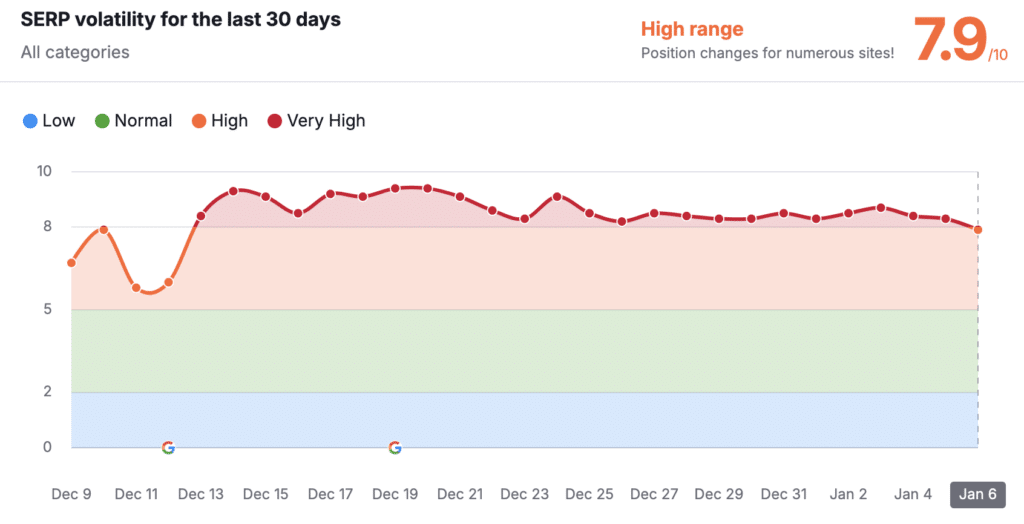
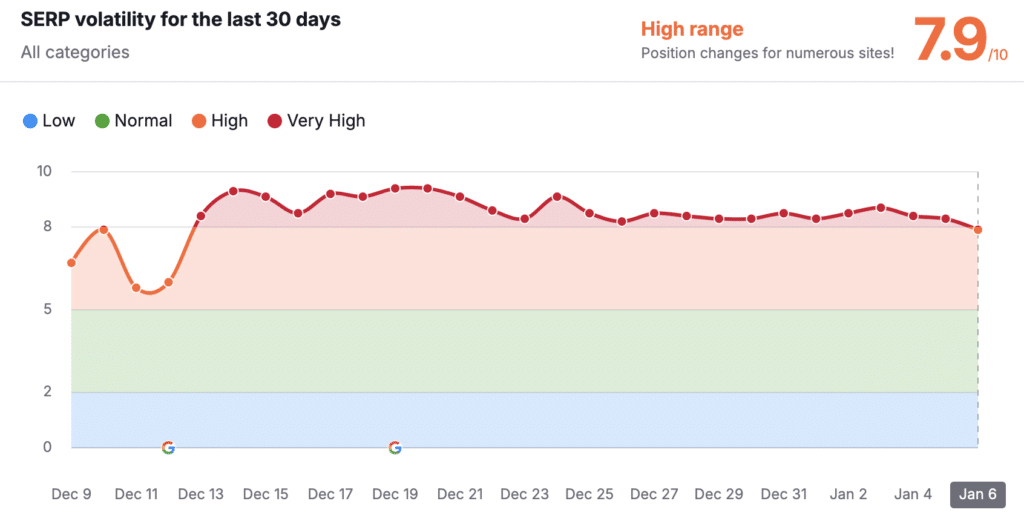
According to recent data from SEMrush’s Sensor tool, the level of volatility in Google’s search results is unusually high. Below is a screenshot showcasing the latest trends:
[Insert Screenshot Here: SEMrush Screenshot Highlighting Volatility]
This spike in activity could indicate algorithm updates, seasonal trends, or even a shift in user search behavior. Regardless of the cause, businesses must adapt their strategies to maintain or improve their online visibility.
Key Causes of Google Search Volatility
- Algorithm Updates: Google’s regular algorithm updates—from broad core updates to niche adjustments—often result in volatility. Recent updates have focused on content quality, site performance, and user experience.
- Seasonality: Search trends can fluctuate based on the time of year. For example, the holiday shopping season typically sees increased competition for retail-related keywords.
- Competitor Activity: Changes in a competitor’s SEO strategy—such as launching new content or earning high-quality backlinks—can also contribute to shifts in rankings.
- Google’s Testing: Google frequently experiments with new features, layouts, and ranking signals, which can temporarily impact search results.
Why Search Volatility Matters for Your Business
Search volatility isn’t just a number on a graph; it has real-world implications for businesses:
- Traffic Fluctuations: Rankings changes can lead to sudden drops or surges in website traffic.
- Revenue Impact: For e-commerce businesses, even slight ranking drops can translate to significant revenue losses.
- Content Strategy Adjustments: Volatility may signal the need to revisit and optimize your content.
How to Respond to Search Volatility
- Monitor Your Rankings: Use tools like SEMrush, Ahrefs, or Google Search Console to track changes in your rankings. Understanding what’s happening is the first step toward addressing it.
- Focus on High-Quality Content: Google’s updates consistently prioritize content that is relevant, authoritative, and user-focused. Regularly update your website with fresh, valuable content.
- Improve Site Performance: Page speed, mobile-friendliness, and overall usability are critical ranking factors. Ensure your website meets Google’s performance standards.
- Diversify Your Traffic Sources: Relying solely on organic traffic is risky during periods of high volatility. Invest in paid ads, email marketing, and social media to balance your traffic.
- Leverage Local SEO: If your business serves a local audience, prioritize local SEO strategies. Optimize your Google Business Profile, build local citations, and encourage customer reviews.
Insights from Industry Experts
To provide further context, we’ve gathered insights from SEO industry leaders:
- Marie Haynes notes that content quality and expertise are becoming increasingly critical ranking factors.
- Barry Schwartz emphasizes the importance of staying agile during algorithm updates and using historical data to identify patterns.
- John Mueller (Google): Recommends focusing on long-term SEO strategies rather than reacting impulsively to short-term ranking changes.
- SEMrush Sensor: Tracks daily SERP fluctuations across industries and provides a volatility score.
- MozCast: Visualizes Google algorithm activity and highlights potential updates.
- Rank Ranger: Offers in-depth insights into ranking shifts and helps identify trends.
- Google Search Console: Provides direct data from Google about your website’s performance in search results.
Proactive Strategies for 2025
As we look ahead, staying proactive is essential. Here are some strategies to future-proof your SEO:
- E-A-T (Expertise, Authority, Trust): Build your website’s credibility by showcasing expert content and earning high-quality backlinks.
- Core Web Vitals: Ensure your website passes Google’s metrics for loading, interactivity, and visual stability.
- AI-Driven Optimization: Use AI tools like ChatGPT to enhance content creation and keyword targeting.
- Voice Search Optimization: Adapt your content for conversational queries to capture voice search traffic.
Harris & Ward’s Approach to Navigating Volatility
At Harris & Ward, we’re no strangers to the challenges of search volatility. Here’s how we help our clients thrive:
- Data-Driven Analysis: We use tools like SEMrush to identify patterns and opportunities.
- Custom SEO Strategies: Our tailored plans ensure that your website remains competitive.
- Content Excellence: We prioritize creating high-quality, optimized content.
- Transparent Communication: We keep our clients informed about changes and recommended actions.
Conclusion
Google search volatility is an inevitable part of digital marketing, but it doesn’t have to derail your business. By staying informed, investing in quality strategies, and partnering with experts like Harris & Ward, you can turn volatility into opportunity. If you’re ready to secure your online presence and drive results, schedule a complimentary strategy call with us today.

Jun 22, 2023 | Chiropractor Marketing, Google, Search Engine Optimization
In the realm of Search Engine Optimization (SEO), link building stands tall as a fundamental strategy for boosting website visibility and driving organic traffic. By strategically acquiring high-quality backlinks, websites can improve their search engine rankings, establish credibility, and attract relevant audiences. This article delves into the significance of link building efforts in SEO, while shedding light on the differences between blog posts, guest posts, and link outreach initiatives.

The Essence of Link Building
Link building serves as the process of acquiring hyperlinks from other websites to your own. Search engines interpret these links as a vote of confidence, signaling that your website offers valuable and authoritative content. In essence, link building is the digital equivalent of word-of-mouth marketing. It helps search engines recognize your website’s relevance and establishes connections that lead to higher rankings.
- Enhancing On-site Link Building: Publishing blog posts on your own website is an excellent way to build a strong foundation for link building efforts. By creating high-quality, informative, and engaging content, you attract readers and increase the chances of obtaining organic backlinks. Each blog post should include internal links, which connect different pages of your website, promoting smooth navigation for users and improving search engine visibility.
Internal links play a crucial role in enhancing the user experience by guiding visitors to relevant pages within your website. From an SEO perspective, internal links distribute the ranking authority across your site, ensuring that all pages have a fair chance of appearing in search results. Additionally, internal links help search engine crawlers discover and index your content more efficiently, improving overall visibility.
Furthermore, blog posts can act as a source of external link building when other websites find your content valuable and link back to it. By consistently producing high-quality blog posts, you establish your website as an authority in your niche, making it more likely for others to reference and link to your content. This, in turn, boosts your website’s credibility and visibility in search engine rankings.
- Expanding Outreach Horizons: Guest posting involves writing articles for external websites within your industry or niche. It allows you to tap into a new audience while gaining valuable backlinks. When contributing a guest post, you can strategically insert relevant links back to your own website. These links serve as a gateway for new users to discover your content and explore your website. Guest posts not only enhance your website’s visibility but also establish your authority within your industry.
Guest posting provides an opportunity to showcase your expertise and reach a broader audience beyond your existing user base. By crafting well-researched and insightful articles, you can capture the attention of readers on authoritative websites. The links you include within the guest posts direct interested readers to your website, increasing traffic and potentially converting them into loyal followers or customers.
When pursuing guest posting opportunities, it is crucial to target reputable and relevant websites. A thorough analysis of their domain authority, readership, and engagement will help you identify suitable platforms for collaboration. By contributing valuable content and adhering to the guidelines of each website, you build a positive relationship with the host website, potentially opening doors for future collaborations and gaining even more visibility and backlinks.
- Forging Connections: Link outreach, also known as link building outreach, is a proactive approach to acquire backlinks. It involves reaching out to website owners, bloggers, and influencers, requesting them to link to your content. Link outreach requires personalized and compelling pitches, highlighting the value and relevance of your website. It is essential to target authoritative websites and build genuine relationships based on mutual interests. Through link outreach, you can expand your network, gain exposure to a wider audience, and strengthen your website’s credibility.
Successful link outreach campaigns begin with identifying target websites that align with your industry or niche. Look for websites that are likely to benefit from linking to your content, such as resource pages, round-up posts, or articles related to your expertise. Craft personalized and concise outreach emails that clearly articulate the value your content provides to their audience and explain why linking to your website would be beneficial.
When conducting link outreach, it is crucial to focus on building genuine relationships rather than simply pursuing backlinks. Engage in meaningful conversations, share relevant insights, and offer support or collaboration opportunities to website owners. By demonstrating your expertise and genuine interest in their work, you increase the likelihood of securing backlinks and establishing long-term partnerships.
Additionally, link outreach can involve other strategies such as broken link building, where you identify broken links on target websites and offer your own content as a replacement. This approach helps website owners improve their user experience by replacing broken links and provides you with an opportunity to acquire high-quality backlinks.
The Role of Link Building in SEO
Link building efforts contribute significantly to SEO success. Here’s how:
- Improved Search Engine Rankings: High-quality backlinks signal search engines about your website’s relevance, boosting its rankings in search results.
- Enhanced Website Authority: Quality links from reputable sources establish your website’s authority, leading to increased trust among users and search engines.
- Increased Organic Traffic: As your website climbs the search engine rankings, it attracts more organic traffic, resulting in higher conversion rates and business growth.
- Brand Exposure and Visibility: Backlinks from authoritative websites increase your brand’s exposure, allowing you to reach a wider audience and build brand recognition.
Link building remains an integral part of any successful SEO strategy. By leveraging blog posts, guest posts, and link outreach efforts, websites can significantly enhance their online presence, climb search engine rankings, and drive organic traffic. A well-executed link building campaign fosters connections, establishes authority, and improves the overall visibility and credibility of your website. Embrace the power of link building and unlock the true potential of SEO.
