Dental Marketing ROI in 2026: SEO vs PPC vs Paid Social (With Realistic Benchmarks)
Dental marketing conversations often revolve around tactics.
“Should we do more Google Ads?”
“Do we need better SEO?”
“Is Facebook still worth it?”
But growth-stage practices and regional groups should be asking a different question:
Which channels produce predictable, scalable patient acquisition at sustainable cost?
In 2026, the answer is rarely one channel. It is a structured mix of SEO, GEO (AI search optimization), PPC, and paid social. Each plays a different role in the patient journey.
This article breaks down how each channel performs, what realistic benchmarks look like, and how growth-stage practices between $800,000 and $5 million should allocate budget strategically.
The Three Primary Acquisition Channels
For most dental practices, digital patient acquisition centers around:
- SEO + GEO (Organic and AI-enhanced search visibility)
- PPC (Google Ads and paid search)
- Paid Social (Meta, Instagram, sometimes YouTube)
Each channel behaves differently in terms of speed, intent, and cost per acquisition.
Understanding those differences is critical for ROI.
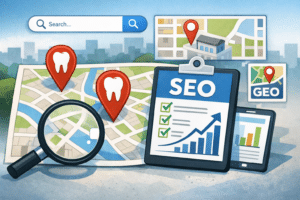
SEO + GEO: Compounding Asset-Based Growth
Search Engine Optimization (SEO) improves your visibility in traditional organic search results. Generative Engine Optimization (GEO) enhances your visibility in AI-generated summaries and conversational search experiences.
Together, they create compounding acquisition.
Strengths of SEO + GEO
- Long-term cost efficiency
- Strong alignment with high-intent search
- Increased brand credibility
- Reduced reliance on paid channels over time
- Improved presence in AI summaries and assistant-style results
Realistic Benchmarks
For growth-stage practices in competitive Southeast or Midwest markets:
- 3–6 months: ranking movement for priority service terms
- 6–9 months: measurable organic traffic growth
- 9–12 months: sustained lead flow increases
Organic traffic growth of 30–50% in year one is achievable when infrastructure and service pages are built correctly.
Long-term cost per acquired patient through SEO is often 30–60% lower than sustained paid search in high-margin service categories.
However, SEO requires patience and disciplined execution. It is not immediate.
PPC (Google Ads): Immediate Visibility with Higher Marginal Cost
Pay-per-click advertising delivers speed.
If you want to appear tomorrow for “emergency dentist near me” or “dental implants cost Nashville,” paid search can make that happen.
Strengths of PPC
- Immediate traffic
- Precise keyword targeting
- Strong intent alignment
- Clear attribution
- Budget control
Challenges
- Rising cost-per-click in competitive markets
- Dependence on continuous spend
- Conversion quality dependent on landing pages
- Susceptible to bidding wars with DSOs
In many metropolitan markets:
- Implant-related keywords often exceed $20–$35 per click.
- Cosmetic dentistry and Invisalign keywords can also carry premium CPCs.
- Emergency keywords are competitive but high-intent.
If your landing pages are not optimized, PPC becomes expensive quickly.
Cost per acquired patient through paid search varies widely, but many practices see higher short-term cost per acquisition compared to mature SEO systems.
Paid Social: Awareness and Demand Creation
Paid social is often misunderstood in dentistry.
Unlike search, social media is interruption-based. Patients are not actively searching for a dentist when scrolling Instagram or Facebook.
However, paid social plays a different role.
Strengths of Paid Social
- Visual storytelling (before/after, smile transformations)
- Brand reinforcement
- Promotion of elective services
- Retargeting website visitors
- Geographic targeting
Limitations
- Lower direct intent
- Longer decision cycle
- Attribution complexity
- Platform algorithm volatility
Paid social is rarely the strongest standalone channel for emergency or insurance-driven dentistry. It performs better for:
- Cosmetic dentistry
- Invisalign
- Smile makeovers
- High-end elective procedures
ROI depends heavily on creative quality and follow-up systems.
The Operator’s View: Channel Roles in a Growth System
Rather than asking which channel is “best,” growth-stage practices should define roles.
SEO + GEO: The Foundation
- Builds durable authority.
- Reduces long-term acquisition cost.
- Supports AI visibility.
- Enhances brand trust.
PPC: The Accelerator
- Captures high-intent traffic immediately.
- Fills short-term pipeline gaps.
- Tests demand for new services.
Paid Social: The Amplifier
- Builds awareness.
- Reinforces positioning.
- Drives elective interest.
- Retargets warm audiences.
The most resilient practices integrate all three strategically.
Budget Allocation Models for Growth-Stage Practices
Let’s model realistic scenarios.
Scenario A: $4,000–$6,000 Monthly Budget
A balanced allocation might look like:
- 50–60% SEO + GEO
- 30–40% PPC
- 10–20% Paid Social (retargeting focus)
This approach builds long-term authority while maintaining short-term lead flow.
Scenario B: $8,000+ Monthly Budget
- 50% SEO + GEO (aggressive service-level authority)
- 30% PPC (high-intent service capture)
- 20% Paid Social (elective promotion + retargeting)
At this level, tracking must connect:
- Leads by service category
- Cost per acquired patient by channel
- Conversion rate per landing page
- Lifetime value by service
Marketing without service-level attribution leads to poor decisions.
Realistic ROI Expectations
Growth-stage practices should evaluate channels using:
- Cost per lead
- Cost per acquired patient
- Production per acquired patient
- Lifetime value
- Payback period
For example:
If an implant case generates $4,000–$6,000 in production, even a $500–$800 acquisition cost may be acceptable.
If hygiene-driven traffic generates lower margin, acquisition thresholds must be lower.
Channel ROI should always be evaluated relative to service value.
How GEO Changes ROI Analysis
AI search introduces a new variable.
When your practice appears in AI summaries or conversational answers:
- Brand trust increases.
- Click-through rates often improve.
- Branded search grows.
- Organic conversion rates rise.
While AI visibility is harder to attribute directly, proxy metrics help measure impact:
- Growth in branded search volume.
- Increase in long-tail question impressions.
- Higher engagement on FAQ-heavy pages.
- Improved conversion rate on organic traffic.
GEO amplifies the ROI of SEO.
Common Mistakes in Channel Evaluation
- Comparing SEO (long-term asset) to PPC (short-term spend) over 30 days.
- Ignoring lifetime value when evaluating cost per acquisition.
- Underinvesting in conversion optimization.
- Running paid ads without strengthening service pages.
- Treating AI search visibility as irrelevant.
Marketing should be evaluated over 6–12 month windows, not weekly dashboards.
The Strategic Takeaway
If you are a growth-stage private practice or regional group in 2026:
- SEO + GEO should form your acquisition foundation.
- PPC should provide immediate intent capture.
- Paid social should amplify elective demand and retarget warm audiences.
Over time, a mature SEO + GEO system reduces your dependency on paid traffic.
Practices that rely entirely on ads are vulnerable to inflation and competitive bidding pressure.
Practices that build structured authority create durable competitive advantage.
Related reading: The Definitive 2026 Dental SEO & AI Search Blueprint and How AI Search Is Changing Patient Acquisition for Dentists.